Emergency Roof Tarping
Emergency Roof Tarping in Wilmington DE
When a storm tears shingles off your Wilmington roof and water is coming in, a properly installed emergency tarp is what stands between the damage you have and the damage you are about to have. We tarp storm-damaged roofs across Wilmington, DE — heavy-duty tarps secured with wood battens at solid anchor points, installed to hold through follow-up weather until permanent storm damage repairs are complete.
Service overview
What does emergency roof tarping actually do?
Emergency roof tarping is temporary weatherproofing: a heavy-duty tarp stretched over the damaged section of your roof and secured so wind and rain cannot get underneath it. It does not fix your roof — it buys time.
A tarp works by creating a continuous waterproof surface over the breach. Wind-lifted shingles, torn flashing and punctures all leave gaps where wind-driven rain enters; the tarp bridges those gaps and sheds water down the slope and into the gutters, the same way intact shingles would. The key is coverage: the tarp must extend well past the damaged area on every side — uphill, downhill and laterally — because water running down the slope will find any exposed edge. A tarp that only covers the visible hole is a tarp that fails in the next rain.
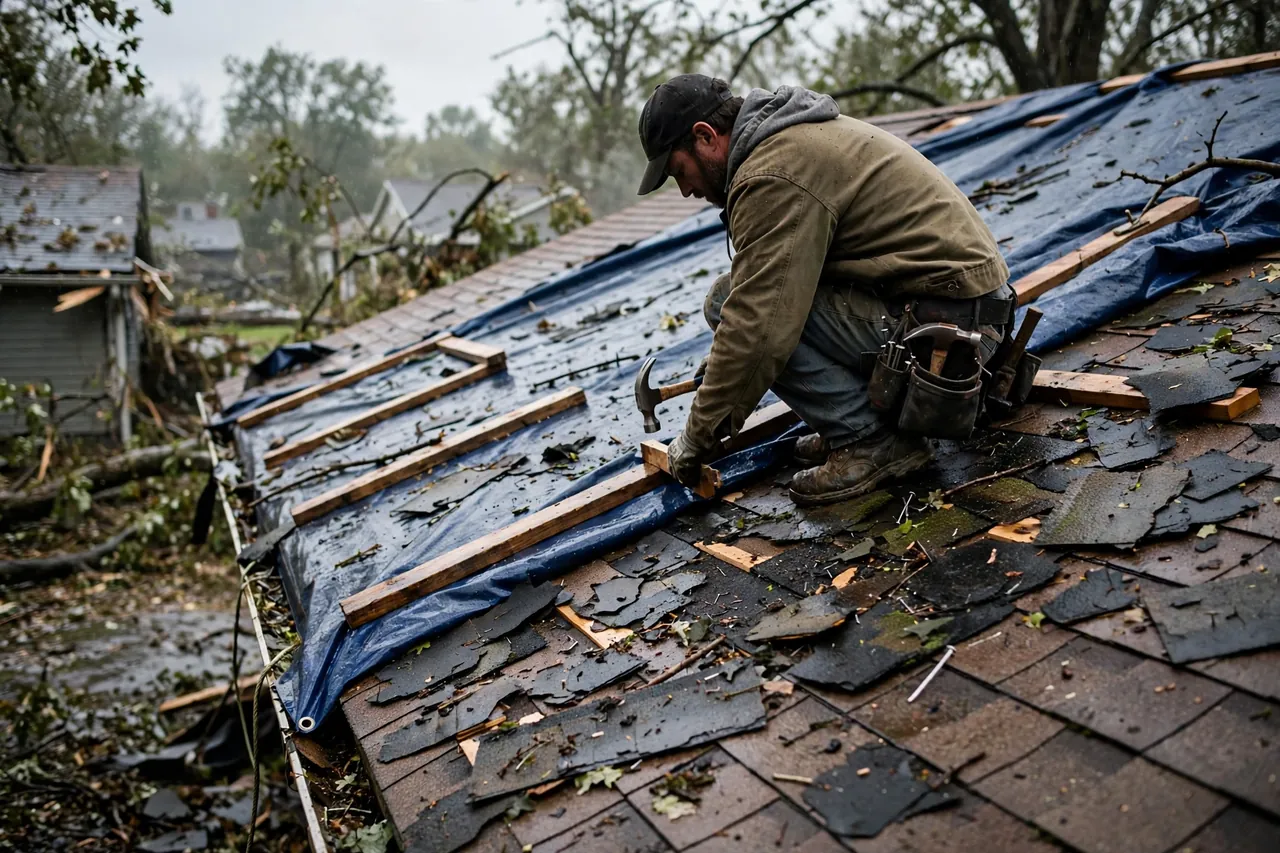
How a tarp is secured matters more than the tarp itself. The right method uses wood battens — strips of lumber laid over the tarp and fastened through it into solid structure like the ridge, the eave or a rafter line — with the fasteners placed where they will be covered by the permanent repair, never through good shingles in the middle of the field. Sandbags, bricks and rope are what you see on DIY tarps; they shift, they abrade shingles, and they let the tarp billow and tear in the next gust. A batten-secured tarp stays put through the nor’easter that follows the thunderstorm.
What tarping does not do is just as important to understand. It does not dry out insulation or decking that is already soaked, it does not stop a leak that is entering through an uncovered section, and it is not a substitute for repair — tarps degrade in UV within weeks to a few months, and every week under a tarp is a week the damaged structure underneath keeps deteriorating. Honest tarping includes an honest conversation about what comes next: a full damage assessment and a written scope for the permanent emergency roof repair that follows.
Timing is the other half of the equation. Tarping should go up as soon as water is actively entering the house — that same day, not after the weekend and not after the next storm in the forecast passes through. Every hour of intrusion soaks insulation, stains ceilings and feeds mold in wall cavities, and the difference between a same-day tarp and a three-day wait is often the difference between a shingle repair and a shingle repair plus drywall and insulation work. If water is coming in tonight, the tarp goes up tonight; the permanent repair gets scheduled from there.
Practical benefits
Why proper emergency tarping matters
A tarp is a small job with an outsized effect on the final repair bill. Here is what correct emergency tarping protects.
Stops the water tonight
The tarp goes over the breach and the intrusion stops — buckets come off the floor, the ceiling stops spreading its stain, and the attic starts drying instead of soaking. Everything downstream of the leak gets immediate relief.
Freezes the damage where it is
Storm damage compounds: soaked underlayment rots decking, wet insulation grows mold, and each new rain exploits the same weak point harder. A secured tarp holds the damage at its current size while the permanent repair is arranged.
Protects the interior of the home
Water that enters through the roof does not stay in the attic — it travels along framing, soaks insulation and appears as stains rooms away from the breach. Tarping the roof entry point protects drywall, flooring and belongings throughout the house.
Supports your insurance documentation
A professionally installed tarp with dated photos shows the damage was mitigated promptly — which is what adjusters expect to see. We photograph the damage before the tarp goes on, so the record is complete and honest.
How service works
How our emergency tarping works
From the first call to the secured tarp, here is exactly what a tarping visit looks like.
STEP 01
Rapid damage assessment
We inspect the roof from the ground and, where safe, from the roof itself — finding every breach, not just the one you called about. Photos document the damage before anything is covered.
Tools and methods
Tools and methods for emergency tarping
Heavy-duty reinforced tarps
Thick woven polyethylene tarps with reinforced edges and grommets — not thin painter’s plastic — rated to hold through weeks of follow-up weather without tearing at the fastener points.
Wood battens and furring strips
Lumber strips that distribute fastener pressure across the tarp, preventing tear-through in high wind. This is the difference between a tarp that holds and a tarp that shreds.
Ring-shank nails and screws
Fasteners driven into solid structure at the ridge, eave and rafter lines — placed deliberately where the coming permanent repair will cover the holes.
Roofing cement and sealant
Used at tarp edges and transitions where wind could work underneath, and to temporarily seal small punctures around the tarped area.
Moisture meter
Checks decking and insulation around the breach for trapped moisture, so we know the true extent of the water damage before the tarp hides it from view.
Fall protection and staging
Roof anchors, harnesses and proper ladder staging for safe work on storm-slickened slopes — tarping is urgent work, and urgency never justifies an unsafe setup.
Where this service fits
When emergency tarping is the right call
Water is actively entering the house.
If buckets are out and the ceiling is staining, the roof needs covering now — not after an inspection is scheduled and not after the next forecast system passes. Tarping first, assessment second, repair third.
Shingles or flashing are missing after a storm.
Bare underlayment visible from the street means the waterproof layer is gone on that section. Underlayment alone will not survive sustained rain — it needs a tarp over it until the storm damage repair is done.
The forecast shows more weather coming.
A damaged roof plus another nor’easter is how a half-day shingle repair becomes deck replacement and interior work. If the radar is lit up, emergency weatherproofing buys protection immediately.
Local execution
Tarping across Wilmington’s neighborhoods
Storms hit every part of Wilmington, but the roofs they hit — and the tarping challenges — differ by neighborhood. Here is what the work looks like across the city.
Trolley Square
Steep Victorian roofs with slate and metal accents need tarps anchored without damaging fragile historic material. We secure at the ridge and eave and avoid fastening through slate courses wherever the geometry allows.
Forty Acres
Broad shingle fields on brick colonials catch full wind loads, so tarps here must be large — covering entire slopes, not patches — and battened heavily at the windward edge where uplift is strongest.
The Highlands
Mature tree cover near Rockford Park means branch punctures more often than wind uplift. Tarping a puncture means covering the hole plus the surrounding bruised shingles, which are weakened even where they look intact.
Riverfront
Unobstructed wind off the Christina River punishes loosely secured tarps. We double up battens on the windward side and seal edges against the sustained gusts these roofs face.
Baynard Village
Mixed-age housing means mixed tarp jobs in one block: older three-tab roofs with brittle shingles that tear if you look at them wrong, beside newer architectural roofs that take battens cleanly. Each gets the method its material allows.
Problems we solve
Tarping problems we solve
These are the situations where a tarp is the difference between a repair and a much bigger job.
Missing shingles with rain in the forecast
Wind strips a section of shingles and the forecast shows rain within 48 hours. We tarp the full slope section the same visit, so the underlayment is never asked to do a shingle’s job in a downpour.
Tree limb puncture through the roof deck
A branch punches through shingles and decking, leaving a hole straight into the attic. The tarp covers the puncture and the surrounding impact zone, where the decking is cracked even beyond the visible hole.
Torn flashing at a chimney or valley during a storm
Driving rain enters where flashing tore away, and the leak tracks far from the entry point. Tarping over the failed flashing section stops the intrusion while the chimney flashing repair is scheduled.
Common in this area
Common emergency tarping scenarios
The calls we get after Wilmington storms — what the homeowner sees, and how the tarping fits into the fix.
Bare underlayment showing after a nor’easter
Symptom: Shingles scattered across the yard, black felt visible from the street, and water spots forming on an upstairs ceiling. Typical fix: Same-visit tarping over the stripped slope, photo documentation of every missing-shingle area, then matched replacement shingles nailed and sealed to spec once the weather clears.
Hailstorm punches holes the adjuster can’t see yet
Symptom: Granules washing out of the downspouts and small dark bruises on shingles, with no active leak — yet. Typical fix: Full-slope assessment first: bruised shingles that lost their granular armor are mapped and photographed. Where the mat is exposed, temporary sealing goes on immediately; where the roof is bruised but intact, the documented scope covers the permanent fix.
Fallen branch through a Highlands roof at night
Symptom: A limb through the roof deck during an overnight storm, rain still falling, attic insulation getting soaked by the hour. Typical fix: Emergency tarp secured over the puncture and the surrounding cracked decking as soon as conditions allow safe roof access, interior water contained, then deck and shingle repair scheduled with the full photo record.
Where we work
One local team. A lot of ground covered.
Downtown WilmingtonHistoric DistrictTrolley SquareHighlandsBaynard VillageRiverfrontForty AcresBrandywine Village
Check my address As soon as water is actively entering — the same day, not after the weekend. Every hour of intrusion soaks insulation and drywall and feeds mold. A tarp that goes up tonight freezes the damage where it is; a tarp that waits three days lets the damage compound into interior work.
A properly installed tarp will not. We fasten wood battens at solid anchor points — ridge, eave and rafter lines — and place fasteners where the coming permanent repair will cover them. We never nail through good shingles in the field of the roof just to hold a tarp down.
A heavy-duty tarp is a weeks-long solution, not a months-long one — UV degrades the material, and the damaged structure underneath keeps deteriorating while it waits. Tarping should always come with a scheduled permanent repair, not an open-ended “we’ll get to it.”
You can, but most DIY tarps fail exactly when they are needed: undersized tarps that don’t extend past the damage, bricks or rope that shift in wind, and fasteners through good shingles that create new leaks. Worse, storm-damaged roofs are slippery and structurally uncertain — falls from roofs are one of the most common serious homeowner injuries.
More than the visible hole. Water enters at the breach and travels along decking and framing, so the tarp must extend well past the damage on every side — uphill especially, since water runs downhill and will exploit any exposed edge above the hole. We verify coverage from the attic side, not just the roof side.
It helps your position, not your payout math — we don’t advise on coverage. What tarping does is document prompt mitigation: dated photos of the damage before the tarp went on, plus a professionally secured tarp, show the loss was contained rather than left to grow. Adjusters expect to see exactly that.
The permanent repair gets scheduled. You receive the damage photos and a written scope: what will be repaired, which materials will match your existing roof, and the sequence of work. The tarp comes off when the repair goes on — it is the first step of the job, not a substitute for it.
Keep exploring
Related Services
Your next step is waiting
Water coming in? Don’t wait for morning.
Call The Roof Medics now. We will get a heavy-duty tarp secured over the damage, document everything the storm did, and lay out the permanent repair — so tonight’s leak doesn’t become next month’s mold and drywall job.
Start with the basics
Contact Us for Roof Repair
Reach out to us for any roof repair needs. We are available Monday to Friday and respond quickly to inquiries.