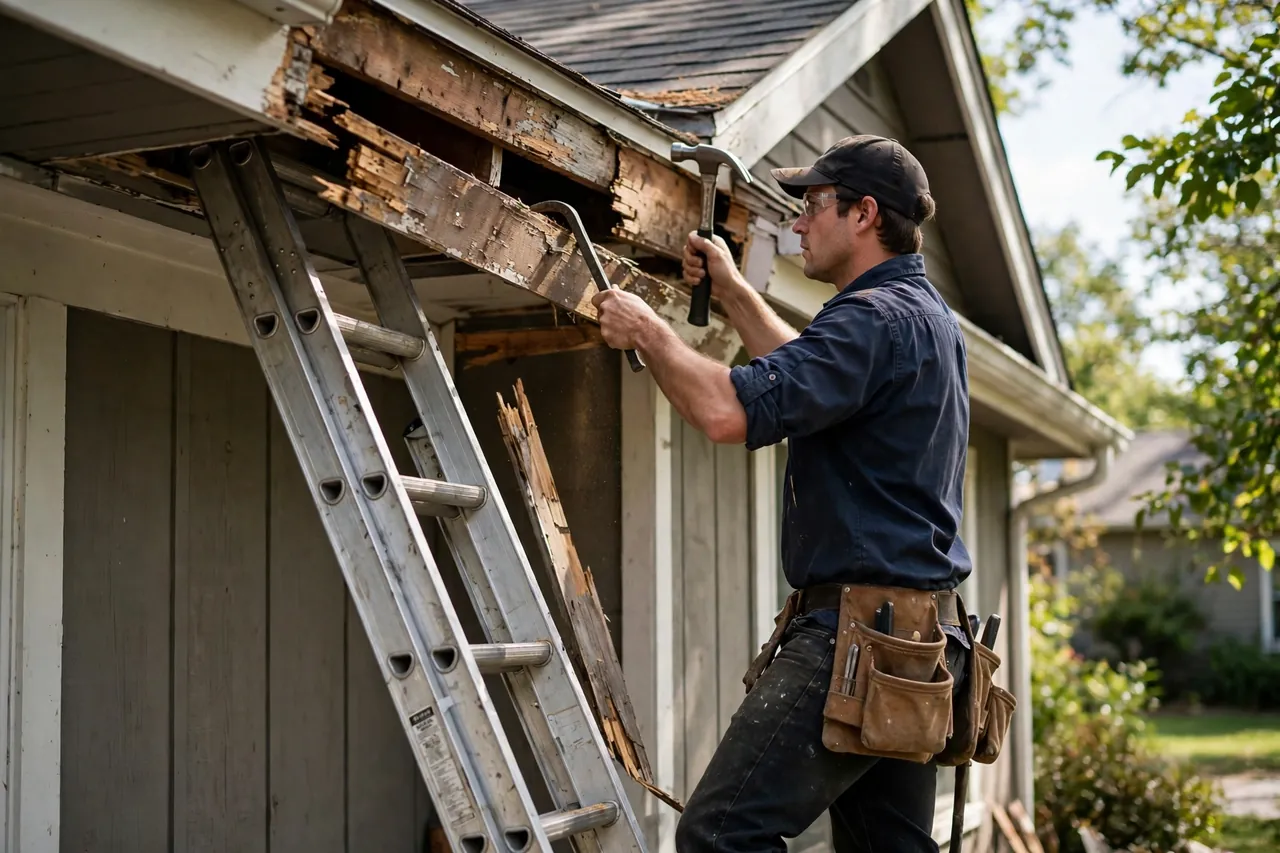
Soffit & Fascia Repair
Soffit & Fascia Repair in Wilmington DE
The fascia is the board your gutters hang from; the soffit is the panel closing the underside of your eaves. When either rots, everything attached to it is in trouble — gutters pull away, animals move into the attic, and water gets behind the boards and into the structure. We repair soffit and fascia across Wilmington, DE: rotted sections cut out and replaced with solid material, entry points closed, and the roof edge left sound enough to hold gutters and shed water properly.
Service overview
What do the soffit and fascia actually do?
Fascia and soffit are the roof’s edge system. The fascia board caps the rafter ends and carries the gutters; the soffit panels close the eave underside and — on most Wilmington homes — carry the intake vents the attic breathes through.
The fascia takes a beating by design. It sits at the drip line, catching splash-back from the roof and the top of the gutter, and it holds the full weight of gutter runs filled with water and debris. When paint fails or flashing laps short, water wicks into the board’s end grain and the rot starts from the back — invisible from the street until the board softens enough for gutters to sag or pull free. By the time a homeowner notices peeling paint on the fascia, the back of the board is often already gone.
The soffit’s job is quieter but just as critical. It seals the eave so wind-driven rain, insects, birds and squirrels cannot get into the rafter bays and attic — and on vented eaves it holds the intake vents that feed the whole roof ventilation loop. A rotted or missing soffit panel is an open door: squirrels chew the soft wood wider within days, and a family of them in the attic brings chewed wiring, contaminated insulation and noise at 5 a.m. that no one forgets.
Repair beats repainting when the wood is compromised — and knowing the difference saves real trouble. Paint over soft wood just hides the rot while it spreads into the rafter tails behind the fascia; within a couple of seasons the repair becomes structural instead of cosmetic. The honest test is a screwdriver: solid wood resists, rotted wood gives. We cut back to sound material, replace with rot-resistant boards, prime and seal all six sides before installation, and make sure the drip edge and gutter apron actually direct water past the new wood instead of behind it.
Soffit and fascia work connects directly to gutter performance, which is why the two so often fail together. A gutter pulling away from rotted fascia cannot be re-hung until the fascia is sound — and a gutter that overflows because it was never pitched right will rot the next fascia board the same way. We treat the edge as a system: sound fascia, sealed soffit, and gutters re-secured to wood that holds, pitched to drain, so the repair lasts instead of repeating.
Practical benefits
Why sound soffit and fascia matter
The roof edge is small in square footage and large in consequences. Here is what solid soffit and fascia protect.
Gutters stay hung and working
Gutters fasten to the fascia — rotted fascia means every hanger is anchored in mush. New, solid fascia gives gutters something to grip, so they hold their pitch and carry water away instead of sagging and spilling it down the wall.
Animals stay outside
Squirrels, birds, bats and insects all exploit soft or missing soffit to reach the attic. Replacing compromised panels and sealing the gaps closes the entry points — the only animal control that actually lasts is the one built into the structure.
Rafter tails are protected
Fascia shields the cut ends of the rafters from weather. When fascia rots through, the rafter tails are next — and rafter-tail repair is structural carpentry, several steps beyond a fascia board swap. Sound fascia is solid protection for the framing.
Ventilation intake is preserved
On vented eaves, the soffit carries the attic’s intake vents. Rotted or painted-shut soffit panels choke the ventilation loop at its source. Repairing the soffit keeps the attic breathing the way the roof system was designed.
How service works
Our soffit and fascia repair process
From the first look at the eaves to a sealed, solid roof edge — how the repair runs.
STEP 01
Eave-by-eave assessment
We probe every fascia board and soffit panel around the house — not just the visibly bad section — marking soft wood, failed paint, animal entry and gutter attachment failures. Photos show you the full extent.
Tools and methods
Tools and methods for soffit and fascia repair
Rot-resistant replacement boards
Boards that stand up to the drip line’s constant wet-dry cycling — installed to shed water, not absorb it, and finished to match the existing trim.
Six-side priming and sealing
Every replacement board is sealed on all faces — including cut ends and the back — before it goes up, because end grain and hidden faces are where rot always starts.
Drip edge and gutter apron
Metal flashing that directs roof runoff past the fascia and into the gutter, instead of letting it curl back behind the boards. The detail that decides whether the repair lasts.
Oscillating and circular saws
Clean, controlled cuts that remove only the rotted section and leave crisp lines for the replacement — no tearing into sound wood or surrounding trim.
Moisture meter
Confirms the wood we keep is actually sound and finds moisture in rafter tails behind the fascia, so hidden damage doesn’t get sealed inside the repair.
Animal-exclusion sealing
Solid closures at every gap and penetration — no foam-only fixes that squirrels chew through in a week. If it keeps weather out, it should keep animals out too.
Where this service fits
When soffit and fascia repair is the right call
Paint is peeling and wood feels soft.
Peeling paint on the fascia with wood that gives under a screwdriver means rot is active — and it started at the back of the board long before the paint failed. Repainting over it just schedules a bigger repair.
Gutters are pulling away from the house.
Gutters don’t pull away from sound wood. Sagging or detaching gutters signal the fascia behind them has softened — the fascia must be repaired before the gutters can be re-hung properly.
Animals are getting into the attic.
Scratching, scampering or chirping from the eaves means something found the soft spot. Trapping the animal without repairing the entry just invites the next one; the soffit repair is the permanent answer.
Local execution
Soffit and fascia repair across Wilmington’s neighborhoods
The roof edge ages differently across Wilmington’s housing stock. Here is what the eaves look like, neighborhood by neighborhood.
Trolley Square
Victorian eaves with decorative trim and complex profiles: repairs here match existing profiles and preserve the historic look while replacing what has rotted — surgical work, not wholesale swap-outs.
Forty Acres
Post-war brick colonials with simple painted fascia that has seen decades of repaints over slowly softening wood. Full fascia runs are often due at once, and the gutter re-hang that follows finally fixes long-standing sag.
Historic District
Original wood eaves on historic homes, where preservation matters and modern aluminum wrap would look wrong. We repair in kind — real wood, properly sealed — to keep the historic character intact.
The Highlands
Heavy tree cover means shaded, slow-drying eaves where moss and moisture linger. Soffit panels here rot from persistent damp as much as from direct leaks, and repairs include making sure the new work can dry.
Baynard Village
Mixed-age blocks where one house has original wood fascia and the next has aluminum-wrapped boards hiding who-knows-what. We check what is actually underneath before quoting — the wrap often conceals the worst of it.
Problems we solve
Soffit and fascia problems we solve
The failure patterns at Wilmington’s roof edges — and how each gets fixed properly.
Back-rotted fascia behind intact paint
The street side looks fine, but water wicked into the board’s back for years and the wood is punky behind the paint. We strip the failed section back to solid wood, replace with sealed rot-resistant boards, and correct the flashing lap that let water behind it in the first place.
Squirrel-chewed soffit panels
A soft panel becomes a chewed hole becomes a squirrel highway into the attic. We evict by exclusion — solid replacement panels, every gap sealed with real material — so the repair is the end of the story, not an intermission.
Fascia too rotted to hold gutters
Gutters sagging and pulling free because their hangers are screwed into mush. New solid fascia goes up first, then the gutter repair: re-pitched, re-hung on proper hangers, and finally able to do its job.
Common in this area
Common soffit and fascia scenarios
The eave problems Wilmington homeowners actually call about — and how they get resolved.
Gutters pulling away after every heavy rain
Symptom: Gutter sections sagging lower each storm, water spilling over the front and down the siding, hangers visibly pulling out of the board. Typical fix: Probing showed the fascia soft along the full run — the hangers had nothing to grip. Full fascia replacement with sealed boards, then gutters re-hung on proper hangers with corrected pitch. The gutters haven’t moved since.
Scratching in the attic at dawn
Symptom: Noise from the eaves in the early morning, then a musty smell developing — classic squirrel tenancy. Typical fix: Inspection found two chewed soffit panels and a gnawed gap at a corner board. Solid replacement panels, all gaps closed with real material, and the attic checked for contamination. Quiet mornings restored.
Peeling paint that keeps coming back
Symptom: Fascia repainted two years ago already peeling again, with the paint bubbling from underneath. Typical fix: The paint was failing because moisture was pushing it off from inside rotted wood. We cut back to sound material, replaced with six-side-sealed boards, corrected the drip edge — and the new finish finally has something solid to hold onto.
Where we work
One local team. A lot of ground covered.
Downtown WilmingtonHistoric DistrictTrolley SquareHighlandsBaynard VillageRiverfrontForty AcresBrandywine Village
Check my address Press it with a screwdriver: solid wood resists, rotted wood dents and gives. Also look for paint that keeps peeling in the same spots, gutters pulling away, or a spongy feel at the board’s bottom edge. Paint failure that returns after repainting almost always means the wood underneath is compromised.
Wrapping over rotted wood hides the problem while it spreads into the rafter tails — we don’t do that. If the wood is sound, a wrap can be a legitimate low-maintenance finish; if it’s rotted, the rotted material comes out first and gets replaced with solid, sealed boards. No cosmetic covers over structural problems.
The fascia is the vertical board capping the rafter ends at the roof edge — it’s what your gutters attach to. The soffit is the horizontal panel closing the underside of the eave between the fascia and the house wall. They fail together often, but they’re different parts with different jobs.
If the sag is caused by rotted fascia — which is the most common cause — then yes, but in the right order: sound fascia first, then the gutters get re-hung on proper hangers with corrected pitch. Re-hanging gutters on rotted fascia just repeats the failure.
Squirrels and birds target wood that’s already soft from moisture — they can chew through a compromised soffit panel in a day. Once one gets in, the opening gets enlarged fast. Solid replacement panels and sealed gaps are the permanent fix; trapping alone just clears the room for the next tenant.
It can improve it. Many Wilmington eaves have intake vents in the soffit that are painted shut, crushed or missing — repairing the soffit is the natural moment to restore that intake. We check the ventilation path while the eave is open and make sure the repair supports the attic’s airflow, not just its appearance.
Most eave repairs on a Wilmington home wrap up in a day or two: assessment, removal of rotted material, replacement with sealed boards, and gutter re-attachment. Full-perimeter jobs on larger homes take longer — you’ll get a straight answer on timing with the written scope before any work starts.
Keep exploring
Related Services
Your next step is waiting
Soft fascia and chewed soffits only get worse.
Call The Roof Medics. We will probe every eave, show you exactly what has rotted and what is still sound, and rebuild the roof edge with sealed, solid material — so your gutters hang true and the attic stays animal-free.
Start with the basics
Contact Us for Roof Repair
Reach out to us for any roof repair needs. We are available Monday to Friday and respond quickly to inquiries.