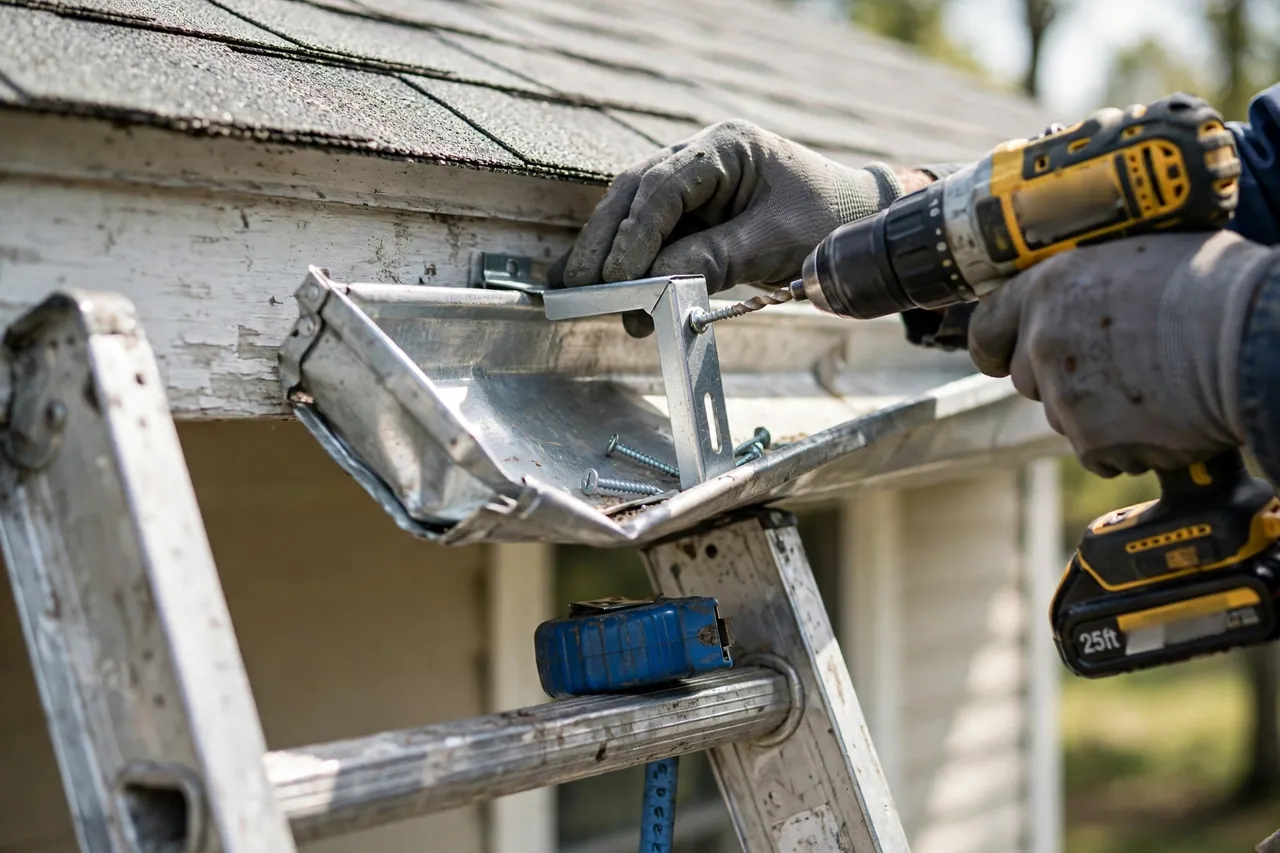
Gutter Repair
Gutter Repair in Wilmington DE
Gutters are the roof’s drainage system — the part that takes thousands of gallons of roof runoff and moves it away from your house instead of down your walls and into your foundation. When runs sag, seams leak and downspouts detach, water goes where it was never meant to go. We repair gutters across Wilmington, DE as part of the roofing system: re-pitching sagging runs, sealing failed seams, and re-securing everything to solid fascia — repair of what you have, not a sales pitch for something new.
Service overview
What does gutter repair actually involve?
Gutter repair is roof protection work. A gutter’s only job is to catch roof runoff and carry it away from the structure — and nearly every gutter failure is a failure to do that one job.
Start with what gutters do for the roof, because it reframes every symptom. A 1,500-square-foot roof sheds roughly a thousand gallons in a single inch of rain; without working gutters, all of it pours off the eaves — eroding soil against the foundation, splashing back onto the fascia and siding, and in winter, feeding the ice that pries at the roof edge. Sagging gutters don’t just look tired; they hold standing water that breeds mosquitoes, adds hundreds of pounds of load to the fascia, and spills over exactly where the house is most vulnerable.
The most common gutter failure is pitch — or the loss of it. Gutters must slope gently toward the downspouts, and they lose that slope as hangers loosen, fascia softens and debris loads the run. A gutter that looks fine from the driveway can hold an inch of standing water along a twenty-foot run, and standing water finds every weak seam and rust spot. Re-pitching means re-hanging the run section by section to restore fall toward the downspout, with hangers anchored into solid wood at proper spacing — not the stretched, sparse hangers that let it sag in the first place.
Seams and joints are the second failure point. Sectional gutters leak where sections meet, where downspouts connect, and at inside and outside corners — the sealant ages, the metal flexes with temperature, and the joint opens. Repair means cleaning the joint back to bare metal, re-sealing with proper gutter sealant, and re-securing the connection so movement doesn’t reopen it next season. Downspouts get the same treatment: re-secured to the wall, elbows re-sealed, and extensions checked to confirm water actually leaves the foundation instead of pooling beside it.
Here is the framing that matters: we repair gutters as part of the roof system, and we say plainly when the gutters aren’t the real problem. Water spilling behind the gutter usually means the drip edge or gutter apron is wrong — a roof-edge issue, not a gutter issue. Rot that keeps returning means the fascia is gone — a fascia repair has to come first. And gutters far beyond repair get an honest assessment, not a patch that fails by spring. Repair-first doesn’t mean repair-only-at-all-costs; it means the right fix for what the inspection actually finds.
Practical benefits
Why gutter repair protects the whole house
Gutters sit at the boundary between roof and foundation — and failures there damage both. Here is what working gutters protect.
Water leaves the foundation alone
The whole point of the system: roof runoff carried to downspouts and away from the house, instead of pouring off the eaves and saturating the soil against the foundation. Repaired pitch and sealed joints make that happen again.
Fascia and siding stay dry
Overflowing and leaking gutters soak the fascia they hang from and splash the siding below — the exact wet-dry cycling that rots wood and stains walls. Gutters that contain their water stop feeding that damage.
No more standing-water load
A sagging run full of standing water is shockingly heavy, and that weight pulls hangers out of the fascia in a slow-motion failure. Re-pitched gutters drain between rains, so the system carries water, not weight.
Winter stops attacking the eaves
Clogged, sagging gutters hold the water that becomes eave ice — and ice pries at shingles, flashing and the roof edge all winter. Gutters that drain properly deny ice dams one of their favorite footholds.
How service works
Our gutter repair process
From the ladder-up look to water-tested drainage — how a gutter repair runs.
STEP 01
Full-run assessment
Every gutter run, downspout and connection gets checked: pitch, hanger condition, seam integrity, fascia soundness behind the hangers, and where the water actually goes. Photos document it all.
Tools and methods
Tools and methods for gutter repair
Hidden hangers and brackets
Screw-in hangers anchored into solid fascia at proper spacing — the holding power that keeps a re-pitched run at its pitch through debris loads and ice.
Gutter sealant
Flexible, weather-rated sealant applied to joints cleaned back to bare metal. The cleaning matters as much as the product: sealant over grime is a temporary rumor of a repair.
Downspout bands and elbows
Proper wall fasteners and replacement elbows that re-secure detached downspouts and redirect discharge away from the foundation.
Levels and string lines
The unglamorous truth of re-pitching: a run is only as good as its fall, and fall is only verified with a level and a line — not by eye from the driveway.
Moisture meter
Checks the fascia behind failing hangers for rot, because re-hanging gutters on rotted wood just schedules the next sag. Sound wood first, always.
Water testing
After the repair, water runs through the system to verify pitch, joints and downspouts under real flow — the repair isn’t done until the drainage is proven.
Where this service fits
When gutter repair is the right call
Water spills over the sides in rain.
Overflow means the run can’t carry its flow — lost pitch, clogged channel or undersized downspout drainage. The water going over the edge is water going down your walls and against your foundation.
Seams drip between rains.
A seam that drips long after the rain stops is holding standing water — which means the pitch is gone in that section. Sealing the seam without restoring pitch just moves the puddle.
Downspouts hang loose or discharge at the foundation.
A detached downspout pours the whole roof’s runoff in one spot beside the house. Re-securing it and verifying the discharge path is one of the highest-value small repairs on the property.
Local execution
Gutter repair across Wilmington’s neighborhoods
Wilmington’s trees, housing ages and rooflines give each neighborhood its own gutter story. Here is what we see across the city.
The Highlands
Mature tree cover near Rockford Park means gutters here live under a constant leaf load — the heaviest debris demand in the city. Repairs focus on pitch that survives the load and hangers spaced to carry it.
Trolley Square
Victorian rooflines with complex eaves and decorative trim: gutter runs follow intricate lines, and repairs match the existing profiles while restoring drainage the historic details were designed around.
Forty Acres
Post-war colonials with decades-old sectional gutters and original hangers stretched past their spacing. Full re-hangs with modern hidden hangers transform how these runs perform.
Riverfront
Wind exposure off the Christina River works gutter fasteners loose over time. Re-securing with proper anchors — and checking every connection after storm season — keeps these runs honest.
Baynard Village
Mixed-age blocks with a patchwork of gutter ages and past repairs: one house needs re-pitching, the next needs seam work, the third needs its fascia fixed first. Each run gets its own assessment.
Problems we solve
Gutter problems we solve
The failure patterns in Wilmington’s gutter runs — and the repairs that actually hold.
Lost pitch and standing water
Hangers loosened over the years, the run settled, and now every rain leaves ponds in the gutter that breed mosquitoes and rot the fascia. We re-hang the run section by section to restore fall toward the downspout, with hangers in solid wood at proper spacing.
Leaking seams and corners
Drips at every joint and corner, staining the siding below. We clean each joint to bare metal, re-seal with proper gutter sealant and re-secure the connection — addressing the movement that opened them, not just the gap.
Gutters pulling away from rotted fascia
The hangers are fine; the wood they grip is mush. No gutter repair holds until the fascia is sound — so the fascia gets repaired first, then the gutters are re-hung on wood that holds.
Common in this area
Common gutter repair scenarios
The gutter calls Wilmington homeowners actually make — and how they get fixed.
Waterfall over the gutter in every storm
Symptom: Sheets of water pouring over the front of the gutter, eroding the planting bed below and splashing the siding. Typical fix: The run had lost its pitch and the downspout was half-detached — the gutter couldn’t move water fast enough. Re-pitched run, re-secured downspout, sealed joints, then water-tested under flow. The next storm stayed inside the gutter.
Drip line staining the siding
Symptom: A dark streak down the siding under every seam, present even in light rain. Typical fix: Every joint seal had aged out and two corners had flexed open. Joints cleaned to bare metal and re-sealed, corners re-secured — the streaks stopped because the water stopped escaping.
Downspout dumping at the foundation
Symptom: A downspout detached from the wall, pouring roof runoff directly beside the foundation, with dampness showing in the basement corner. Typical fix: Downspout re-secured with proper wall bands, elbow replaced and discharge redirected away from the house. Small repair, outsized protection — that one downspout was delivering the whole roof’s water to the worst possible spot.
Where we work
One local team. A lot of ground covered.
Downtown WilmingtonHistoric DistrictTrolley SquareHighlandsBaynard VillageRiverfrontForty AcresBrandywine Village
Check my address Cleaning fixes debris; repair fixes the gutter itself. If water still overflows after cleaning, seams drip between rains, runs visibly sag, or downspouts hang loose — that’s repair territory. A good test: watch the gutters in rain after they’ve been cleaned. What you see then is the gutter’s real condition.
Usually a combination: hangers loosening over time, hangers spaced too far apart from the original install, debris load stressing the run, and — the big one — fascia softening behind the hangers so the screws lose their grip. Lasting repair addresses the cause, not just the sag.
Most leaking seams seal just fine: clean to bare metal, proper gutter sealant, re-secured connection. Replacement enters the conversation only when the metal itself is failing — widespread rust-through, split seams or runs damaged beyond re-pitching. We’ll tell you honestly which side of that line your gutters are on.
Lost pitch is the usual suspect — the run settled and water can’t reach the downspout fast enough. Also common: downspouts discharging poorly, or water shooting over the gutter because the drip edge lets it run behind. The inspection finds which one, because each has a different fix.
Our work is repair: re-pitching, re-hanging, sealing and re-securing the gutters you have. If an honest assessment finds sections beyond repair, we’ll say so plainly and explain exactly why — but we don’t sell gutter installation as a service.
Directly. Failed gutters soak the fascia they hang from, splash water back under the drip edge, and feed the eave ice that pries at shingles all winter. We treat gutters as part of the roofing system — which is why every gutter assessment includes a look at the fascia and roof edge behind it.
Any time they’re failing — waiting only lets the damage spread to fascia and siding. That said, late fall after the leaves drop is the natural moment: the year’s debris is out, winter is coming, and the repair goes into the harshest season working properly.
Keep exploring
Related Services
Your next step is waiting
Gutters should carry water away, not hold it.
Call The Roof Medics. We will assess every run, downspout and connection, show you where the pitch failed and the seams opened, and repair the drainage system your roof depends on — re-pitched, re-sealed and re-secured to solid wood.
Start with the basics
Contact Us for Roof Repair
Reach out to us for any roof repair needs. We are available Monday to Friday and respond quickly to inquiries.