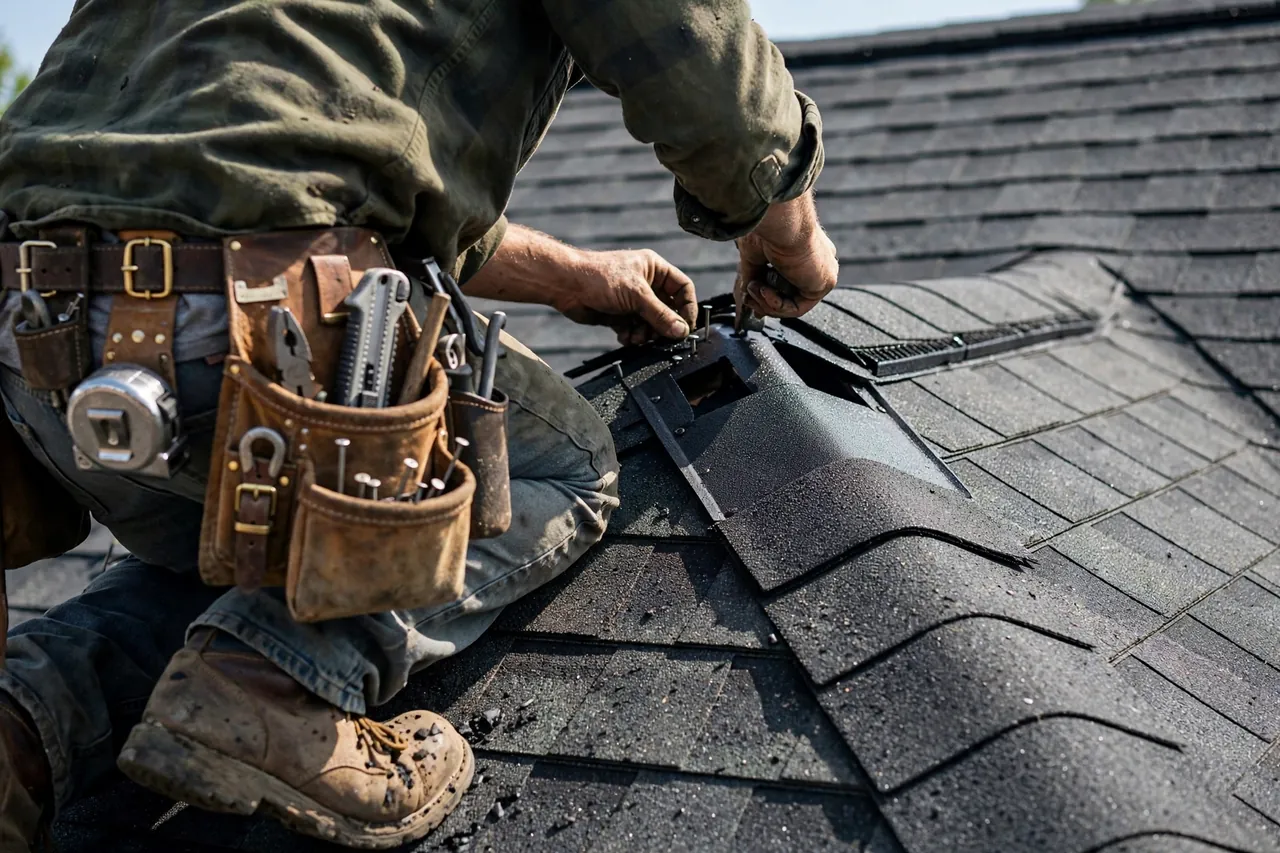
Roof Ventilation Repair
Roof Ventilation Repair in Wilmington DE
Your attic is supposed to breathe — cool air in through the soffits, hot moist air out through the ridge. When vents clog, collapse or were never balanced properly, heat and moisture get trapped against the underside of your roof and quietly destroy it from within. We repair roof ventilation systems across Wilmington, DE: ridge vents, soffit vents and the airflow path between them, restored so your attic vents the way it was designed to.
Service overview
How does roof ventilation actually work?
A vented attic works on a simple loop: intake low, exhaust high. Soffit vents under the eaves admit cool outside air; ridge vents along the peak let hot air escape. Heat rising through the attic drives the cycle passively, around the clock.
That loop does three jobs at once. In summer, it carries superheated attic air out before it can bake the shingles from underneath — attic temperatures on an unvented Wilmington roof routinely top what the shingles were designed to endure, and that underside heat ages shingles years ahead of schedule. In winter, the same airflow keeps the attic cold, which keeps snow on the roof frozen evenly instead of melting from below and refreezing at the eaves as ice dams. And year-round, it exhausts the moisture that migrates up from kitchens, bathrooms and laundry rooms before it can condense on cold decking.
Ventilation fails in predictable ways. Ridge vents get crushed by foot traffic or clogged with debris and paint; soffit vents get buried under blown-in insulation during an attic insulation job, choking off the intake the whole system depends on; bathroom exhaust fans get vented into the attic instead of outside, pumping gallons of moisture directly onto the decking every shower. Any one of these breaks the loop — and a loop with no intake or no exhaust is the same as no ventilation at all.
Repair means restoring the loop, not just swapping a vent cover. We check the full airflow path: intake area at the soffits versus exhaust area at the ridge, because the two must be balanced — too much exhaust with too little intake pulls conditioned air from the house and can draw rain in through the ridge vent in wind-driven storms. We clear blocked soffits, repair or replace damaged ridge vent sections, re-route misdirected bath fans to proper roof or wall terminations, and verify baffles keep insulation from re-choking the intake. The goal is a system, not a part.
The symptoms of failed ventilation masquerade as other problems, which is why they go misdiagnosed. Curling shingles get blamed on shingle age when the real culprit is underside heat; ice dams get blamed on gutters when the real culprit is a warm attic melting snow from below; attic mold gets blamed on a roof leak when the real culprit is trapped household moisture with nowhere to go. Before you replace shingles, re-hang gutters or chase a phantom leak, check whether the attic can breathe.
Practical benefits
Why ventilation repair pays for itself
Ventilation is invisible when it works and punishing when it doesn’t. Here is what restoring the airflow protects.
Shingles last their full life
Underside heat is a silent shingle killer — it dries out the asphalt, curls the tabs and voids the aging curve the roof was designed for. A vented attic keeps shingle temperatures in their designed range, so the roof ages on schedule instead of ahead of it.
Ice dams lose their fuel
Ice dams form when a warm attic melts roof snow from below; the meltwater refreezes at the cold eaves and backs up under the shingles. A cold, well-vented attic keeps the whole roof surface at one temperature — and takes away the melt-freeze cycle that builds the dam.
Attic moisture gets an exit
Every shower, every laundry load and every simmering pot sends moisture upward. Without exhaust, it condenses on the coldest surface available — usually the roof decking — feeding mold and rotting sheathing. Restored ventilation gives that moisture somewhere to go.
Comfort and energy follow
A superheated attic radiates heat down into living spaces all summer, and a moisture-laden attic degrades insulation’s effectiveness year-round. Homeowners often notice cooler upstairs rooms and steadier temperatures after the ventilation loop is restored.
How service works
Our ventilation repair process
From attic assessment to verified airflow — how a ventilation repair runs.
STEP 01
Attic and roof assessment
We inspect the attic for heat damage, moisture staining, mold growth and insulation blocking the soffits, then examine the ridge vent, soffit vents and all penetrations from the roof side.
Tools and methods
Tools and methods for ventilation repair
Ridge vent replacement sections
Matching ridge vent material cut and woven into the existing ridge cap, sealed and fastened so the peak exhausts evenly along its full length — no dead zones.
Soffit vent repair and baffles
Damaged soffit panels repaired or replaced, with insulation baffles installed in every rafter bay to hold an open air channel from eave to ridge that insulation cannot re-choke.
Moisture meter and hygrometer
Measure trapped moisture in decking and current attic humidity, so we know whether the ventilation failure has already damaged the structure it is supposed to protect.
Thermal observation
Reading attic temperature patterns shows where heat is pooling and where airflow is dead — the map that tells us which vents are working and which are decorative.
Exhaust re-routing kits
Insulated ducting and proper roof or wall caps that take bathroom and kitchen exhaust out of the attic entirely, instead of pumping household moisture onto the decking.
Roofing cement and sealants
Seal every new vent penetration and flashing transition against wind-driven rain, because a vent that admits weather is worse than the stagnant air it replaced.
Where this service fits
When ventilation repair is the right call
Your attic is stifling in summer.
If the attic feels like an oven by mid-afternoon, the exhaust side of the loop is failing — heat that should be leaving through the ridge is pooling against the decking and baking the shingles from below.
Ice dams form every winter.
Recurring ice dams with intact shingles and clean gutters point at a warm attic, not a gutter problem. Ventilation repair keeps the attic cold and takes away the melt-freeze cycle at its source.
Mold or moisture stains in the attic.
Dark staining on decking, frost on nails in winter, or a musty attic smell all signal trapped moisture. Clearing the exhaust path — and re-routing any bath fans venting into the attic — stops the moisture at its source.
Local execution
Ventilation repair across Wilmington’s neighborhoods
Wilmington’s varied housing stock means ventilation fails differently from block to block. Here is what we find across the city.
Trolley Square
Victorian attics with complex rooflines and dormers often have ventilation added as an afterthought — box vents that short-circuit the ridge, or no intake at all. We map the actual airflow and rebuild the loop the roofline allows.
Forty Acres
Post-war capes and ranches with blown-in insulation are the classic choked-soffit case: an insulation upgrade buried every intake vent. Baffles and cleared soffits restore the intake the system was designed around.
Historic District
Historic homes with original construction may have minimal or no designed ventilation — attics that were never meant to breathe by modern standards. Repairs work within what the structure allows, prioritizing the highest-impact fixes.
Riverfront
Newer construction near the Christina River usually has designed ventilation, but wind exposure punishes ridge vent failures fast — a lifted or crushed ridge section here admits wind-driven rain, not just air. We repair and re-secure to hold.
Baynard Village
Mixed-age housing with a patchwork of past roof work: ridge vents installed without matching soffit intake, bath fans venting into attics, turbines frozen solid. Each house gets the loop diagnosed from scratch.
Problems we solve
Ventilation problems we solve
The failure patterns behind Wilmington’s hottest, dampest and iciest attics.
Insulation-choked soffit intake
A well-meaning insulation upgrade buries every soffit vent, and the ridge vent starts pulling conditioned air — and sometimes rain — from the house instead of fresh air from the eaves. We pull back the insulation, install baffles in every bay, and restore the intake the exhaust was designed for.
Bath fans venting into the attic
One of the most common and most damaging finds: a bathroom exhaust terminating in the attic, pumping warm moist air directly onto cold decking every shower. We re-route it through insulated duct to a proper exterior cap — often the single highest-impact fix in the attic.
Crushed or painted-shut ridge vent
Foot traffic during past roof work crushes ridge vent sections flat; repainting seals the slots shut. The attic loses its exhaust and heat pools at the peak. We replace the damaged sections and verify full-length airflow.
Common in this area
Common ventilation repair scenarios
What brings Wilmington homeowners to call about ventilation — and what the fix looks like.
Curling shingles on a roof that isn’t that old
Symptom: Tabs curling and granules shedding on shingles with plenty of rated life left, and no storm history to blame. Typical fix: Attic inspection found soffit vents buried under insulation and attic temperatures far above design range — the shingles were being baked from below. Baffles, cleared soffits and a repaired ridge vent restored the loop; the remaining shingle life is now the roof’s, not the attic’s, to determine.
Ice dams every February despite clean gutters
Symptom: Thick ice ridges at the eaves each winter, water backing up under the shingles, gutters cleaned and intact. Typical fix: Thermal patterns showed a warm attic melting snow from below. Restoring balanced intake and exhaust brought the attic down to outdoor temperature, evening out the roof surface so snow stays frozen instead of melting and refreezing at the eaves.
Musty attic and dark-stained decking
Symptom: A musty smell on the upper floor and dark staining spreading across the attic side of the sheathing. Typical fix: Moisture readings confirmed chronic condensation; the culprit was a bath fan venting into the attic plus a painted-shut ridge vent. Re-routed exhaust, replaced ridge sections and verified airflow — the staining stops spreading once the moisture has an exit.
Where we work
One local team. A lot of ground covered.
Downtown WilmingtonHistoric DistrictTrolley SquareHighlandsBaynard VillageRiverfrontForty AcresBrandywine Village
Check my address The classic signs: a stiflingly hot attic in summer, ice dams in winter, curling shingles on a roof that isn’t old, musty smells, or dark staining on the attic side of the decking. Any one of these means the intake-exhaust loop is broken somewhere — and an attic inspection will show exactly where.
Ridge vents run along the roof peak and exhaust air evenly across the whole attic; box vents (turtle vents) are individual units that exhaust only the area around them. Ridge vents are generally more effective on a standard gable roof, but they only work with matching soffit intake — a ridge vent with choked soffits pulls air from the house instead.
Imbalance is the real problem, not quantity. Too much exhaust with too little intake creates negative pressure that pulls conditioned air from living spaces and can draw wind-driven rain in through the ridge vent. That is why repair includes measuring intake against exhaust, not just adding more vents.
Flat and low-slope roofs ventilate differently — often through the roof assembly itself rather than an attic loop — but trapped heat and moisture damage them just as surely. If your flat roof blisters or the rooms below run hot, the ventilation strategy needs a professional look, not a shingle-roof answer.
It removes their fuel. Ice dams need a warm attic melting snow from below; a properly vented attic stays at outdoor temperature, so snow stays frozen instead of melting and refreezing at the eaves. Ventilation repair plus proper insulation is the lasting ice-dam answer — not heat cables, which treat the symptom.
Yes — it is one of the most damaging things we find. Every shower pumps warm, moisture-laden air directly onto cold roof decking, where it condenses and feeds mold and rot. Re-routing that fan to the exterior is often the single highest-impact repair in the whole attic.
Only at the vent locations themselves. Ridge vent sections are replaced along the peak, soffit panels are repaired from below at the eaves, and exhaust re-routing uses small, properly flashed penetrations. The field of the roof — your shingles — stays intact.
Keep exploring
Related Services
Your next step is waiting
Is your attic working against your roof?
Call The Roof Medics. We will assess your attic’s airflow — intake, exhaust and everything in between — and repair the ventilation loop so heat and moisture leave your roof alone. Your shingles, your decking and your winter eaves will all thank you.
Start with the basics
Contact Us for Roof Repair
Reach out to us for any roof repair needs. We are available Monday to Friday and respond quickly to inquiries.