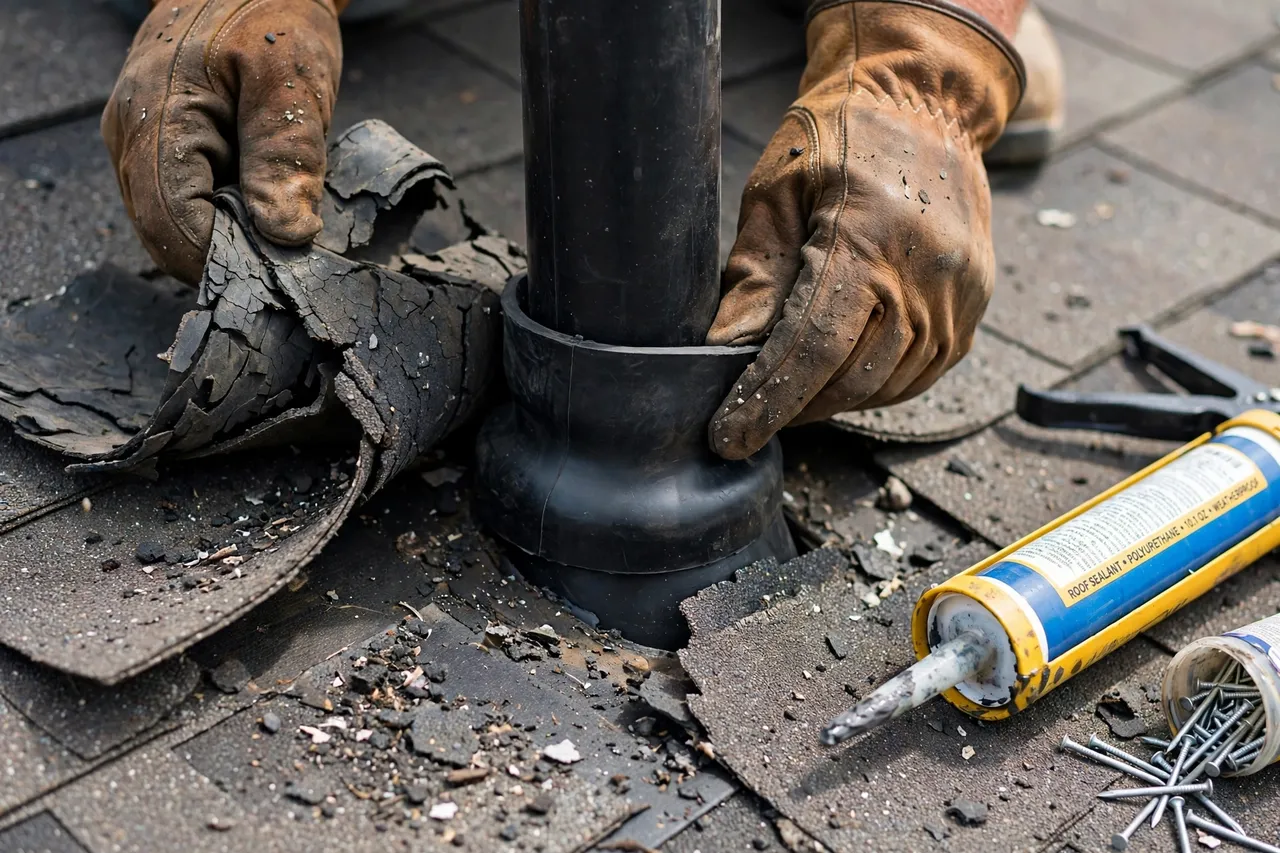
Pipe Boot Repair
Pipe Boot Repair in Wilmington DE
The most common small roof leak in Wilmington starts at a part most homeowners have never heard of: the rubber pipe boot. It is the collar that seals the gap where a plumbing vent pipe passes through your roof — and after long exposure to sun and temperature swings, the rubber cracks, shrinks and lets water in. Our pipe boot repair service in Wilmington, DE replaces the failed boot properly, shingles and all, so the drip that stained your ceiling stops for good.
Service overview
What is a pipe boot — and why does it fail?
Every plumbing vent pipe that pokes through your roof needs a seal where it passes the shingles. That seal is the pipe boot — a small part with an outsized job.
Your home’s plumbing vents through the roof. Those black pipes sticking up through the shingles carry sewer gas out and let air into the drain system, and every one of them pierces the roof surface. Around each pipe sits a pipe boot: a metal base flange that slides under the shingles above the pipe and over the shingles below it, with a rubber collar that grips the pipe itself. It is a simple part — a few dollars of rubber and metal — and it is the only thing standing between the rain and the hole in your roof.
The rubber collar is the weak point. Neoprene rubber hardens with ultraviolet exposure and repeated heating and cooling, and after a number of seasons it cracks, splits or pulls away from the pipe. The first crack is small — a hairline in the collar that only admits water when rain runs down the pipe itself. But every storm widens it, and the water drips straight down the pipe into the attic, soaking the insulation around it and staining the ceiling below.
Wilmington’s climate is hard on rubber boots. Hot, humid summers bake the collar, and cold snaps shrink it; the cycle repeats every year, and the rubber gives up sooner than the shingles around it. A roof can have many sound years left in its shingles and still develop a boot leak — the boots simply age faster than the field. That is why a boot failure is not a sign of a failing roof, only of a small part that has reached the end of its own service life.
Done right means replacing the boot, not caulking it. A bead of sealant around a cracked collar buys a season, then cracks again as the rubber keeps shrinking. A proper repair removes the shingles around the pipe, lifts out the old boot, slides a new boot over the pipe, seats its flange correctly under the upper shingles, and re-lays the courses so the repair is part of the roof again — not a patch stuck on top of it. The work takes an hour or so per boot, and the leak it cures has often been staining ceilings for far longer.
Practical benefits
Why a proper boot replacement matters
A pipe boot is a small part, but the leak it causes is not small. Here is what replacing it properly protects.
The stain stops for good
A cracked boot drips down the vent pipe and stains the ceiling below, season after season. Replacing the boot closes the entry at the pipe itself, so the drip — and the stain — stop at the source.
No more sealant cycles
Sealant over a cracked collar cracks again as the rubber underneath keeps shrinking, while the attic insulation keeps getting wet. A new boot ends the cycle.
Dry insulation and decking
Water running down a vent pipe soaks the insulation around it and the decking beneath the boot. Left alone, that damp patch grows into rotted sheathing. A new boot keeps the whole area dry.
Every boot gets checked
A roof usually has more than one vent pipe, and boots installed at the same time age together. During the repair we check them all, so you know the state of every boot — not just the one that leaked first.
How service works
Our pipe boot repair process
From the stain below to the new boot above — here is the pipe boot repair sequence, step by step.
STEP 01
Tracing the leak to the boot
We check the attic around the vent pipe for staining and damp, and inspect the boot from the roof — looking for cracks, shrinkage and gaps in the rubber collar where it meets the pipe.
Tools and methods
Tools and methods for pipe boot repair
Replacement pipe boots
New boots matched to the pipe diameter, with a flexible rubber collar and a metal base flange — sized to the pipe, not forced onto it, so the collar grips without stretching.
Shingle remover and pry bar
Shingles around the pipe are lifted and their nails released without cracking the surrounding courses, so the repair area ties back into the roof cleanly.
Roofing nails and sealant
The new flange is fastened through the shingles above it, and a bead of sealant closes the nail heads and the collar-to-pipe joint
Utility knife
The old boot’s collar is cut away from the pipe cleanly, and shingle edges around the repair are trimmed so the re-laid courses sit flat.
Attic inspection light
From the attic, the vent pipe and the decking around it are checked for staining and damp — the underside shows how long the boot has been leaking and whether the decking needs attention.
Photo documentation
The cracked collar, the removed boot and the new boot in place are all photographed. You see the small part that caused the stain, and the new one that replaced it.
Where this service fits
When you need pipe boot repair
A stain appears below a vent pipe, with no other roof damage.
A brown ring on a ceiling directly below a plumbing vent is the signature of a cracked boot. The roof around it looks fine because it is fine — the only failure is the small rubber collar where the pipe passes through.
The rubber collar is cracked, split or pulling away from the pipe.
A collar that has hardened and split, or shrunk back from the pipe leaving a visible gap, is already leaking — the boot needs replacing, not resealing.
A previous sealant fix lasted one season, then the stain returned.
Sealant over a cracked boot always fails the same way: the rubber underneath keeps shrinking, the sealant cracks with it, and the leak returns. If a boot has already been sealed once, it is time for a new boot.
Local execution
Pipe boot repair across Wilmington’s neighborhoods
Every Wilmington neighborhood has vent pipes — and every boot ages the same way. Here is where the small leaks usually show up, area by area.
Trolley Square
Victorian homes with vent pipes threaded between dormers and chimneys: the boots are hard to see from the ground, and the leak often stains a ceiling far from the pipe. Attic tracing finds the guilty boot among several.
Forty Acres
Brick colonials with multiple bathrooms mean multiple vent pipes, and the boots were all installed at the same time — when one cracks, the others are close behind.
Historic District
Older vent stacks with boots replaced at different times over the years, so one roof can carry boots of several ages. Each boot is inspected on its own, and only the failed ones are replaced.
The Highlands
Tree-shaded slopes keep the shingles cooler but the boots still age from the inside out — the rubber hardens whether or not the sun hits it directly. The leak here often hides under a shaded, damp patch of roof.
Baynard Village
Mixed-age stock means some roofs still carry their original boots beside newer ones from past repairs. The repair always starts with a full count of every vent pipe, so no aging boot is missed.
Problems we solve
Pipe boot problems we solve
The patterns behind Wilmington’s most common small leaks — and how each one gets fixed.
The cracked collar
Ultraviolet exposure and temperature swings harden the rubber collar until it splits, and rain running down the pipe slips straight through the crack. The fix is a new boot: the old one comes off, the new collar grips the pipe, and the stain below dries out for good.
The shrunken boot
The collar shrinks back from the pipe over time, leaving a visible gap that admits wind-driven rain. Sealant fills the gap for a season, then cracks as the rubber keeps shrinking. A new boot sized to the pipe closes the gap properly.
The boot that was never seated right
A boot installed with its flange over the upper shingles instead of under them lets water run beneath the flange and into the roof. The repair removes it, seats the new flange in the correct order, and re-lays the courses so water sheds over the boot, not under it.
Common in this area
Common pipe boot repair scenarios
Real pipe boot repairs from Wilmington homes — the symptom, and the small part behind it.
A stain that grew slowly for a year
Symptom: A faint ring on a hallway ceiling darkened a little after every storm, with a roof that looked perfect from the ground. Typical fix: Attic inspection traced the damp to a vent pipe, and the boot’s collar had a hairline crack on the downhill side. A new boot, fitted in under an hour, ended a leak that had been staining the ceiling for a year.
Three stains, one culprit
Symptom: Stains in three different rooms after a wet spring had the homeowner convinced the whole roof was failing. Typical fix: Moisture tracing showed all three trails converging on one cracked boot at the ridge. One new boot resolved what looked like a whole-roof problem.
A sealant fix that failed twice
Symptom: Two rounds of sealant around the same boot had each held for a season, and the stain kept returning a little larger each time. Typical fix: The rubber underneath had shrunk so far that no sealant could bridge the gap. The old boot came off, a new one went on with the flange seated correctly, and the third fix was the one that held.
Where we work
One local team. A lot of ground covered.
Downtown WilmingtonHistoric DistrictTrolley SquareHighlandsBaynard VillageRiverfrontForty AcresBrandywine VillageCool SpringHedgevilleHilltopThe FlatsNorthwest WilmingtonQuaker Hill
Check my address The signature is a stain on a ceiling below a plumbing vent pipe, with a roof that otherwise looks sound. From the attic the trail is clear: damp and staining around the vent pipe itself, with dry decking elsewhere.
Sealant is a short-term patch, not a repair. The rubber underneath keeps shrinking and hardening, so the sealant cracks with it — usually within a season. Replacing the boot is the lasting fix, and it is quick work: the old boot comes off, a new one goes on, and the shingles are re-laid around it.
The rubber collar ages faster than the shingles around it — sun and temperature swings harden it over time. When one boot on a roof fails, the others installed at the same time are usually close behind, which is why we inspect every boot during a repair visit.
No. Only the shingles immediately around the pipe are lifted, the old boot is removed, the new one is fitted, and the same shingles are re-laid over the new flange. The rest of the roof is never touched, and the repair is invisible from the ground.
Not necessarily. Each boot is inspected on its own — collar condition, fit around the pipe, flange seating — and only the failed ones are replaced. Boots installed together do age together, though, so when one fails the others get a close look and you get a straight answer on each.
Yes, given time. Water running down the vent pipe soaks the insulation and the decking around the pipe, and over seasons that damp patch rots the sheathing. During the repair the decking around the pipe is checked, and if it has softened it is rebuilt as part of the same visit.
It is small, but it should not wait. The drip is slow and steady, and every storm adds water to the insulation and decking around the pipe. A boot replaced promptly is a quick repair.
Keep exploring
Related Services
Your next step is waiting
A small leak from a small part — fixed in one visit.
Call The Roof Medics. We will trace your stain to its source, check every vent boot on your roof, and replace the failed ones properly — so the drip that has been staining your ceiling stops for good.
Start with the basics
Contact Us for Roof Repair
Reach out to us for any roof repair needs. We are available Monday to Friday and respond quickly to inquiries.