Your local team · Northwest Wilmington
Roof Repair in Northwest Wilmington, DE
Roof repair in Northwest Wilmington, DE means working on the tree-lined streets northwest of downtown — brick colonials and American foursquares from the first half of the 1900s, mid-century ranch homes, and hip roofs shaded by some of the city's oldest trees. The Roof Medics repairs shingle, chimney, and gutter systems across Northwest Wilmington, from Brandywine Park to the residential blocks beyond. If your roof is leaking, your chimney flashing has failed, or your gutters are packed with leaves, contact our team or call (302) 445-8567.
Local knowledge
Why Roof Repair in Northwest Wilmington Is Different
Northwest Wilmington is the city's older residential northwest — the tree-lined blocks running from the Brandywine Park area outward, where the housing stock runs from brick American foursquares and colonials built in the first half of the 1900s to mid-century ranch and split-level homes. Half of these homes were built before the mid-1950s, which makes this one of the city's most established — and most roof-maintenance-intensive — residential areas.
The defining feature of a Northwest Wilmington roof is the tree canopy. Mature oaks and maples shade whole blocks, and shade changes how a roof ages: north-facing slopes stay damp long after rain, encouraging moss and algae that work under shingle tabs; branches overhang ridges and drop limbs in storms; and every fall, the canopy unloads into every valley, gutter, and low spot behind a dormer. We see more gutter and valley work in Northwest Wilmington than anywhere else in the city — not because the roofs are worse, but because the trees never stop. A yearly clearing plus a spring roof inspection is the maintenance rhythm these blocks were made for.
The housing stock splits into two clear eras. The older blocks carry brick American foursquares and colonials from the early-to-mid 1900s — hip roofs or steep gables, tall brick chimneys, dormers, and original woodwork at the eaves. These houses were built well, and their roofs fail at the details: chimney flashing where mortar has eroded, step flashing along dormer cheeks, valleys worn by a century of concentrated runoff. The mid-century blocks carry ranch and split-level homes with lower-pitched roofs — simpler planes, but original 1950s–70s shingles on some, with brittle sealant strips and tired pipe boots. Targeted shingle repair serves both eras: renew the details, replace the damaged courses, and the sound structure underneath keeps working.
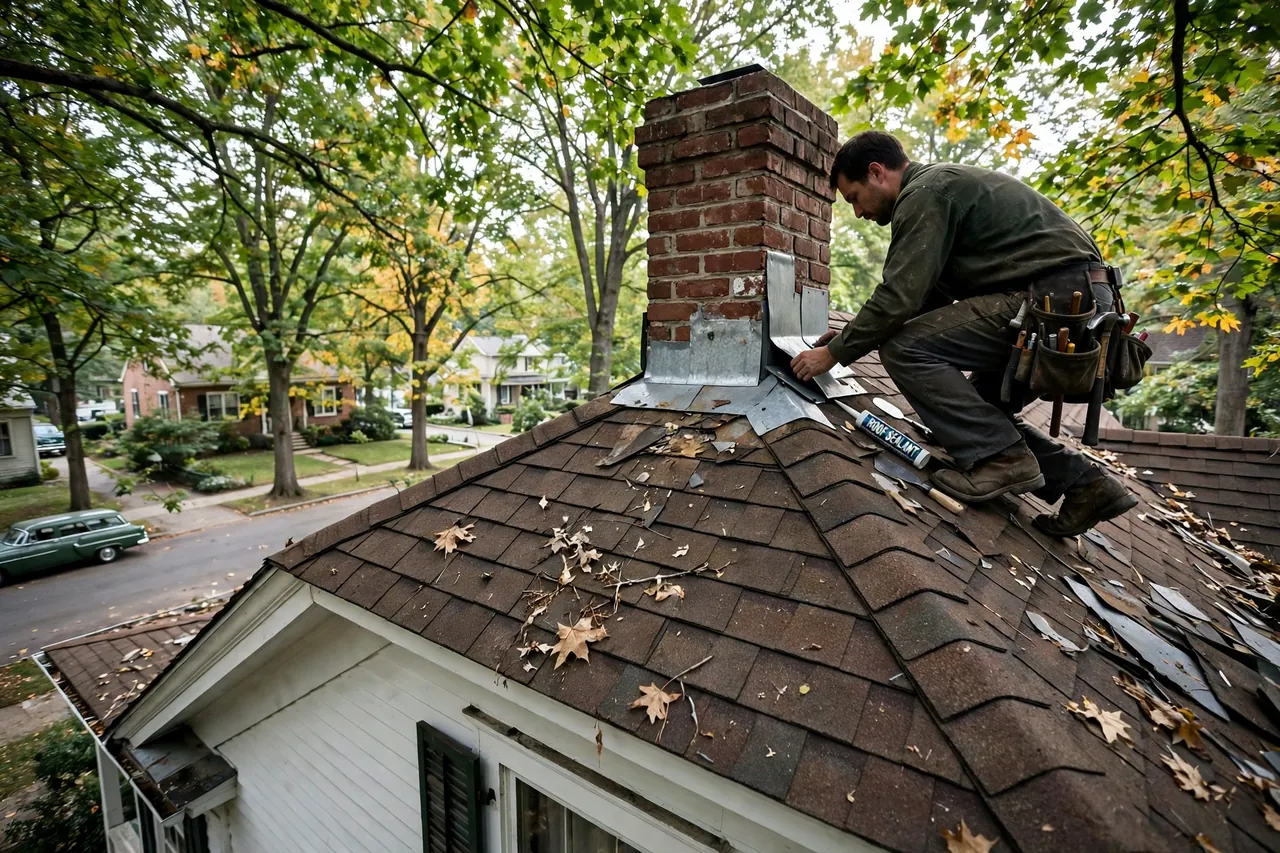
Chimneys are the neighborhood's signature repair. The tall brick stacks on the foursquares and colonials are 70 to 100 years old — mortar joints eroded, step flashing corroded, crowns cracked. Chimney leaks are the most misdiagnosed calls we get from Northwest Wilmington: the stain appears far from the stack because water rides the flashing down before it finds a ceiling. Our chimney flashing repair is methodical for exactly this reason — repoint the failing mortar, install new step and counter flashing, seal the crown — so the chimney stops feeding water into the attic for good.
Dormers and hip-roof details add the fine work. Foursquares and colonials love dormers — shed, gable, and eyebrow — and each one is a flashed intersection where the dormer cheek meets the main slope. Original wood siding on dormer cheeks rots where flashing has failed, and the repair has to handle both: new cheek flashing tucked properly under the siding, and any rotted trim renewed. Hip roofs concentrate water at the hips and ridges the same way gables concentrate it in valleys, so ridge caps and hip flashing get the same careful attention we'd give a valley on a steeper roof.
The mid-century homes bring their own pattern. Ranch roofs are low-pitched and simple — fewer details to fail, but when the original shingles finally give out, they give out across the whole plane at once: brittle tabs, widespread granule loss, sealant strips that no longer seal. On these homes, honest leak detection matters most at the transitions — where the low-slope garage or addition roof meets the main house wall, and where decades of leaf compost have been quietly working under the eaves. We fix what's failed and say plainly what's next, so the homeowner plans instead of reacts.
Common local problems
Common Roof Types and Problems in Northwest Wilmington
From Brandywine Park outward, Northwest Wilmington's roofs follow the tree canopy and the two housing eras. Here is what we most often repair — and how each roof type tends to fail.
Foursquare and colonial hip roofs
The brick foursquares and colonials of the older blocks carry hip roofs or steep gables in architectural shingles — many on their second or third roofing. Water concentrates at hips, ridges, and valleys; flashing at these intersections wears faster than the field. We renew hip and ridge flashing, replace wind-damaged courses, and re-flash the valleys so the concentrated water has a sound path off the roof.
Tall brick chimney stacks
Seventy-to-100-year-old chimneys with eroded mortar, corroded step flashing, and cracked crowns. Chimney leaks travel — the stain often appears far from the stack — which is why they're misdiagnosed so often. We repoint failing mortar, install new step and counter flashing, and seal the crown: the full chimney flashing repair, not a caulk patch.
Dormer cheek and valley flashing
Shed, gable, and eyebrow dormers on the older homes each bring cheek flashing where the dormer meets the main slope. Failed cheek flashing rots the dormer's wood siding from behind — a repair that needs both new flashing and renewed trim. We rebuild the flashing properly tucked under the siding and replace what the water damaged.
Mid-century ranch and split-level roofs
Lower-pitched roofs on the 1950s–70s homes, many still carrying aging original or second-generation shingles. Brittle tabs, widespread granule loss, tired pipe boots, and failed flashing where low-slope additions meet the house wall. Targeted shingle repair handles the transitions and damaged sections; we say plainly when the plane is telling a bigger story.
Leaf-loaded gutters and valleys
The canopy takes its toll: valleys packed with composting leaves, gutters overflowing in every fall storm, downspouts clogged at the elbows. Standing moisture rots fascia and works under shingle tabs. Our gutter repair — re-pitched runs, sealed seams, re-secured downspouts — plus valley clearing keeps the tree debris from becoming roof damage.
Low-slope garage and addition roofs
Ranch homes often grew a low-slope garage or family-room addition, roofed in rolled roofing or membrane. Ponding, seam failures, and flashing breakdown where the addition meets the main house wall are the pattern — repaired with membrane patches and rebuilt wall flashing, the same approach as our flat roof repair.
Common in this area
Common Roof Repair Scenarios in Northwest Wilmington
These are the jobs we see again and again in Northwest Wilmington — described as patterns, not anyone's story.
Chimney leak misdiagnosed as a roof leak
Symptom: A stain spreads on a bedroom ceiling, but the shingles around it look fine — the water is entering at the chimney's failed step flashing and traveling down before it shows. Typical fix: Repoint the eroded mortar, install new step and counter flashing around the stack, and seal the crown — repairing the chimney as a system instead of patching the nearest shingles.
Valley packed with leaf compost
Symptom: Water backs up under the shingles at a valley during fall storms, staining the ceiling below — seasons of leaf compost have been holding moisture against the valley flashing. Typical fix: Clear the valley fully, assess the flashing underneath, renew the valley metal where it's corroded, and set the homeowner up on a fall clearing rhythm.
Ranch roof aging out at the transitions
Symptom: A 1960s ranch shows brittle shingles across the plane, but the active leaks are at the pipe boots and where the addition meets the house wall. Typical fix: Renew the boots and transition flashing, replace the damaged courses, and give an honest read on the plane's remaining life — fixing what's failed now and planning what's next.
We know the route
Landmarks Near Northwest Wilmington
Northwest Wilmington's landmarks are green ones — the parks that define the area double as our navigation points.
Brandywine Park
The area's great green anchor, stretching along the Brandywine through the northwest. Its canopy is the source of the leaf load — and the shade patterns — that shape every roof we work on in this part of the city.
The Josephine Fountain
The park's landmark fountain, a gathering point for generations of Wilmingtonians. The mature trees around it are exactly the kind that overhang neighboring roofs — beautiful, and relentless on gutters.
The Brandywine Zoo
Set within Brandywine Park, the zoo marks the park's northern reach. The residential blocks fanning out from the park — foursquares giving way to mid-century homes — are the roofs we know best up here.
The Jasper Crane Rose Garden
The park's formal garden, a reminder that this area has been Wilmington's green edge for a very long time. The older homes nearest the park carry the original chimneys and dormers that make Northwest Wilmington's repair work so detail-driven.
Plan for the season
How Seasons Affect Roof Repair in Northwest Wilmington
Delaware's four-season climate works every weakness in older homes under a tree canopy. Here is how the year typically plays out in Northwest Wilmington.
Spring
Nor'easters and heavy April rains test every chimney flashing, dormer cheek, and valley in the area. Spring is the right time to assess winter's damage — lifted tabs, mortar loosened by freeze-thaw, valleys packed with winter debris — before summer storm season.
Summer
Heat and humidity accelerate shingle aging and dry out sealants around flashings and pipe boots. Afternoon thunderstorms bring the year's strongest gusts — and falling limbs — which find loose tabs and overhanging branches first.
Fall
The canopy's main event: oaks and maples unload into every valley, gutter, and dormer low spot in Northwest Wilmington. A fall clearing — valleys, gutters, downspout elbows — is the single most valuable maintenance these roofs get all year.
Winter
Freeze-thaw cycles pry at chimney mortar, flashing seams, and the sealant strips on aging ranch roofs. Ice dams can form where heat escapes into the attics of the older foursquares, backing water under the courses at the eaves — the classic winter leak on a shaded north slope.
Services available in Northwest Wilmington
Our Roof Repair Services in Northwest Wilmington
Every service below is available in Northwest Wilmington, tuned to the area's older homes and tree canopy. See all of our roof repair services, or learn more about our team.
01
Chimney Flashing Repair
The area's tall old brick stacks are classic leak sources. We repoint eroded mortar, install new step and counter flashing, and seal the crown so the chimney stops feeding water into the attic.
View service 02Shingle Roof Repair
For foursquares, colonials, and ranch homes alike, we replace damaged courses, renew pipe boots and flashings, and match existing shingle profiles across both housing eras.
View service 03Roof Inspection
A careful inspection maps the chimneys, dormers, valleys, and transitions — so you know exactly what needs repair, what the trees are doing to your roof, and what can wait.
View service 04Gutter Repair
Leaf-loaded gutters are a way of life under this canopy. We re-pitch runs, seal seams, clear and re-secure downspouts, and renew rotted fascia so the drainage system keeps up with the trees.
View service 05Storm Damage Roof Repair
Nor'easters and summer thunderstorms hit the canopy first — then the roofs. We assess the full roof after a storm: lifted tabs, damaged flashing, limb impact, and debris-packed valleys.
View serviceWhere we work
One local team. A lot of ground covered.
Downtown WilmingtonHistoric DistrictTrolley SquareHighlandsBaynard VillageRiverfrontForty AcresBrandywine VillageCool SpringHedgevilleHilltopThe FlatsNorthwest WilmingtonQuaker Hill
Check my address The mature canopy over Northwest Wilmington drops leaves, twigs, and seed pods from spring through late fall — valleys and gutters under overhanging branches can pack solid in weeks. Regular clearing, especially in fall, keeps that debris from backing water under the shingles.
Very often, yes. Failed step flashing and eroded mortar joints are invisible from the ground, and chimney leaks travel — the stain can appear far from the stack. A close-up chimney inspection, not a ground-level look, is what finds it.
It helps with limb impact and reduces — not eliminates — leaf load. But trimming doesn't fix flashing that's already failed or shingles that are already aging. We recommend handling the tree work and the roof work as complementary, not as substitutes.
Once a year, ideally in spring after winter's freeze-thaw cycles, plus after any major nor'easter or windstorm — and a fall gutter and valley clearing is close to mandatory under this canopy. Catching a failed flashing early keeps a small repair small.
Usually. We remove the affected siding courses, install new cheek flashing properly integrated with the water-resistive layer, and reinstall the siding — renewing only the trim the water actually damaged.
Often, for the transitions: pipe boots, addition flashing, and damaged courses can be renewed to buy meaningful time. We'll give you an honest read on the plane's overall condition too — repair-first doesn't mean repair-only when the roof is telling a bigger story.
Yes. Garage and family-room additions with shallow pitches get membrane repairs — adhered or heat-welded patches — plus rebuilt wall flashing where the addition meets the main house.
Your next step is waiting
Trees, Chimneys, and Old Details? Let's Look.
Northwest Wilmington roofs reward a roofer who reads the details — the chimney mortar, the dormer cheeks, the valleys under the canopy. Call The Roof Medics for an honest assessment: we'll show you exactly what needs repair and what can wait.
Start with the basics
Contact Us for Roof Repair
Reach out to us for any roof repair needs. We are available Monday to Friday and respond quickly to inquiries.