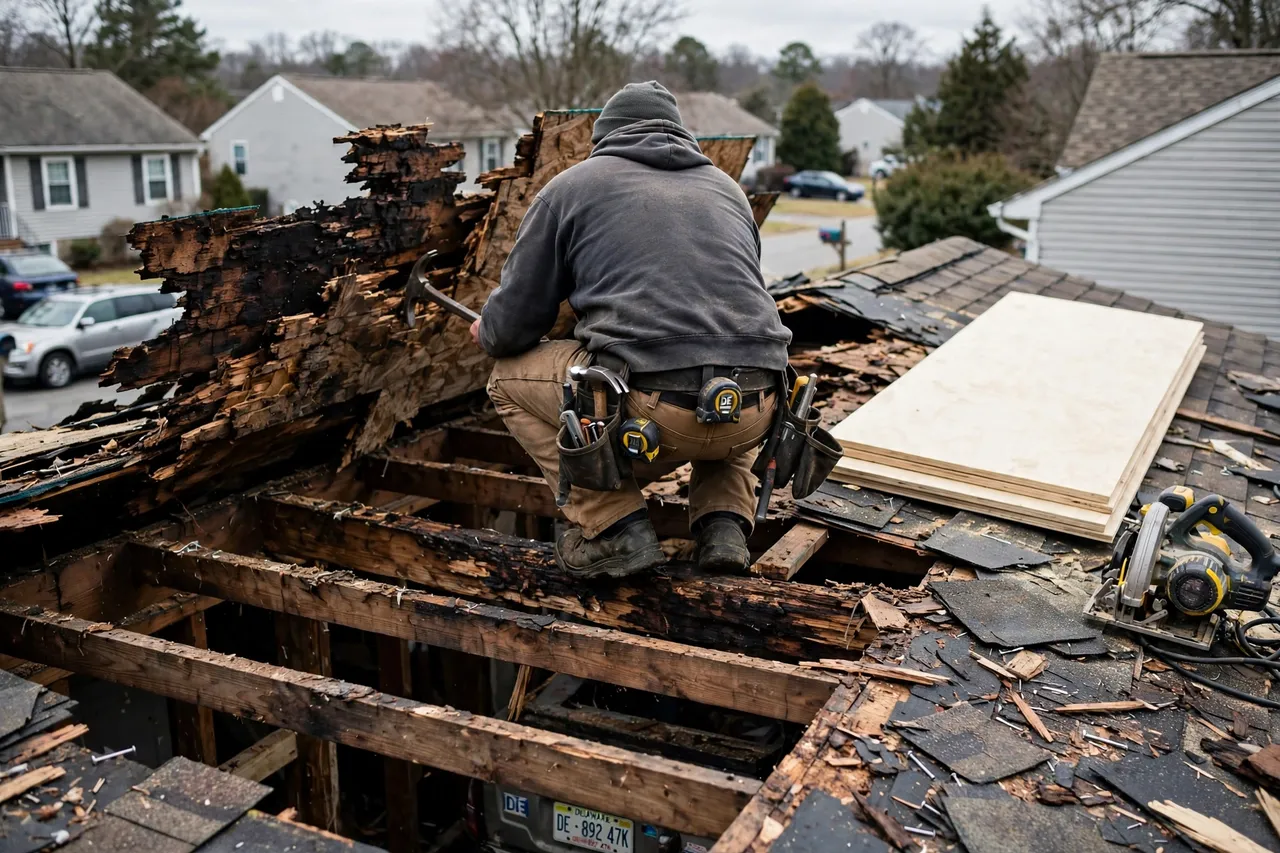
Roof Deck Repair
Roof Deck Repair in Wilmington DE
Shingles are only as sound as the decking beneath them. When the plywood or board sheathing under your roof rots, softens or sags, nails lose their grip, shingles lift and curl, and every rainstorm pushes water deeper into the structure. Our roof deck repair service in Wilmington, DE cuts out the failed sheathing and rebuilds the deck section by section — so the new shingles go onto solid wood, not onto a surface that is already giving way.
Service overview
What is the roof deck — and why does it fail?
The roof deck is the sheet of plywood or boards nailed to your rafters. It is the foundation every shingle, flashing and underlayment depends on — and when it fails, nothing above it holds properly.
Think of your roof as a sandwich with three working layers. On top sit the shingles, shedding rain and sun. Beneath them is the underlayment, a secondary water barrier. And beneath that is the deck — the plywood or board sheathing fastened to the rafters that gives the whole assembly its shape and strength. Every nail that holds a shingle bites into the deck, and every footstep a roofer takes lands on it. When the deck softens, rots or delaminates, the roof above it starts failing in ways that look like shingle problems but are not.
Decking fails slowly, and almost always from water that has been getting in for a long time. A small leak at a flashing or a cracked pipe boot lets moisture reach the sheathing, and the wood stays damp season after season. Plywood delaminates — its layers separate and crumble. Board sheathing rots along the grain and turns soft and punky. By the time the ceiling stains, the decking above it has often been wet for months.
Wilmington’s housing stock makes deck problems common. The city’s older homes carry board sheathing — individual planks with gaps between them — that has been absorbing and drying for decades, and the gaps let moisture and air move in ways plywood does not. Mid-century homes carry early plywood that is thinner than what is used today and more vulnerable to delamination once water reaches it. And the city’s humid summers and freeze-thaw winters keep any damp decking cycling between wet and frozen, which breaks wood fibers apart faster than steady dampness alone would.
Deck repair is structural work, not cosmetic work. The rotted section has to be cut out back to solid wood at the nearest rafters, new sheathing fitted and fastened to the framing, underlayment replaced over the repair, and shingles re-laid so the patched area sheds water exactly like the roof around it. A proper deck repair fixes the foundation, and only then the surface.
Practical benefits
Why deck repair matters before anything else
A roof can only be repaired from the top down if the bottom layer holds. Here is what fixing the deck protects.
Shingles that stay put
A shingle nail needs solid wood to grip. In rotted decking, nails pull out under wind and thermal movement, and whole courses lift and curl. Rebuilding the deck gives every new shingle a firm anchor, so the repair above it lasts.
The sag stops spreading
A soft deck section sags between rafters, and the sag creates a shallow bowl that holds water instead of shedding it. That standing water soaks the next section, and the soft area grows.
No more mystery leaks
Water that enters through a failed flashing and soaks into the deck can travel along the sheathing and appear inside far from the entry point. A sound deck with fresh underlayment closes the hidden pathways water was using.
A repair scope based on evidence
You get the rotted sections marked, photographed from above and below, and a written scope that shows exactly which decking is being replaced and why — not a vague promise that the roof was “fixed.”
How service works
Our roof deck repair process
From the first soft step on the roof to the last shingle re-laid — here is the deck repair sequence, step by step.
STEP 01
Finding the full extent
We walk the roof feeling for soft spots and sag, then check the same area from the attic, where staining and damp on the underside of the decking show how far the rot has spread beyond what the surface reveals.
Tools and methods
Tools and methods for deck repair
Moisture meter and probe
Pin readings and a simple awl probe separate wood that is merely damp from wood that has lost its structure. The probe test is decisive: sound wood resists, rotted wood gives way.
Circular saw with depth control
Set to cut just through the sheathing and no deeper, so the rotted deck comes out cleanly without scoring the rafters beneath it.
Chalk lines and straightedges
Cut lines are snapped to the center of the rafters on every side, and the finished patch is checked against a straightedge — a flush deck is what keeps shingles lying flat.
Pry bars and shingle removers
Shingles and underlayment are lifted back past the repair area without tearing the surrounding courses, so the re-laid shingles tie back into a roof that was never disturbed.
Attic inspection light
From underneath, raking light across the decking reveals staining, sag between rafters and old water trails that the roof surface hides. The underside tells the truth about the deck’s condition.
Photo documentation
Every soft spot, every cut line and every fitted patch is photographed. You see the rot we found, the framing underneath it, and the finished repair.
Where this service fits
When you need roof deck repair
The roof feels soft or spongy underfoot.
A deck that gives under a step has lost its structure — the wood fibers have broken down and the sheathing is no longer carrying load. The soft section needs to come out.
A section of roof is visibly sagging between rafters.
A sag that shows from the ground means the decking has deflected well past its limit, and the dip is now holding water after every rain. The longer it sags, the more water it collects, and the faster the surrounding decking follows.
Shingles keep lifting in the same spot after repairs.
When the same course lifts again after being re-nailed, the problem is not the shingle — it is the decking underneath refusing to hold a fastener. Until the deck is rebuilt, no shingle repair in that spot will hold.
Local execution
Deck repair across Wilmington’s neighborhoods
Wilmington’s housing stock gives each neighborhood its own deck story. Here is where the sheathing usually gives out, area by area.
Trolley Square
Victorian roofs with board sheathing and complex dormer intersections: rot hides in the gaps between planks and at the dormer valleys. Deck repair here means working around old framing and matching plank thickness so the surface stays level.
Forty Acres
Broad shingle slopes on brick colonials with mid-century plywood that delaminates once a flashing leak reaches it. The rot often spreads wider than the stain below suggests, so the attic is checked first to map the true extent.
Historic District
Some of the city’s oldest decking — original boards, sometimes with early repairs layered over them. Rotted sections are cut back to solid rafters, and the repair has to respect framing that predates modern spacing.
The Highlands
Branch strikes near Rockford Park puncture shingles and split the decking beneath, and the damage is easy to miss from the ground. A punctured deck lets water straight into the attic, so the repair covers the full impact zone, not just the visible hole.
Baynard Village
Mixed-age stock means mixed decking on the same block: brittle board sheathing beside thinner early plywood. Each house gets its own assessment from the attic down — never an assumed deck condition.
Problems we solve
Deck problems we solve
The patterns behind Wilmington’s failing roof decks — and how each one gets rebuilt.
The delaminated plywood field
A slow flashing leak soaks one area of plywood for seasons until its layers separate and crumble underfoot, and the shingles above look fine until the deck can no longer hold their nails. The fix is a roof leak repair at the source plus cutting the delaminated field back to solid rafters and fitting new sheathing.
The sagging valley deck
Valleys carry the most water on the roof, so the decking beneath a worn valley fails first — sagging between rafters and holding water in the dip. The repair rebuilds the valley deck, replaces the valley underlayment, and re-lays the valley so water runs off instead of pooling.
The rotted board-sheathing gap
On older board-sheathed roofs, rot concentrates where planks meet and at the eaves, and the gaps let a small leak wet a wide area. The repair cuts the rotted boards back to sound wood, fits new boards at matching thickness, and seals the repair with fresh underlayment.
Common in this area
Common roof deck repair scenarios
Real deck repairs from Wilmington homes — the symptom, and what the deck underneath was hiding.
A dip in the roof visible from the street
Symptom: One slope had a shallow sag that had been growing for a year, with a ceiling stain below it that kept returning after two patch jobs. Typical fix: Attic inspection showed a four-by-six-foot section of plywood delaminated from a long-dead chimney flashing leak. The rotted deck came out to the rafters, new sheathing went in flush, and the flashing was rebuilt at the same time.
Shingles lifting along one course every winter
Symptom: The same course lifted and curled each cold season, and re-nailing it never held more than a few months. Typical fix: The decking under that course was soft from a valley leak above it, and the nails had nothing to grip. The repair rebuilt the valley deck and the affected course area, and the new shingles sit on solid wood for the first time in years.
A soft spot found during a routine inspection
Symptom: A homeowner asked for a full roof inspection before a sale, and the walk found one spongy patch near a skylight curb. Typical fix: The decking around the skylight was rotted from a slow curb leak, though the skylight itself was sound. The repair replaced the decking and rebuilt the curb flashing.
Where we work
One local team. A lot of ground covered.
Downtown WilmingtonHistoric DistrictTrolley SquareHighlandsBaynard VillageRiverfrontForty AcresBrandywine VillageCool SpringHedgevilleHilltopThe FlatsNorthwest WilmingtonQuaker Hill
Check my address The clearest signs are a soft or spongy feeling when the roof is walked on, a visible sag between rafters, shingles that keep lifting in the same spot, and staining on the underside of the decking seen from the attic. A ceiling stain is a late sign — by the time it shows, the decking above it has usually been wet for a long time.
Yes — that is how most deck repairs work. The rotted section is cut out back to the nearest rafters on all sides, new sheathing is fitted to the framing, and the shingles are re-laid over the repair. The rest of the roof stays untouched, and the patched area sheds water exactly like the roof around it.
Because a shingle nail needs solid wood to hold. In rotted decking the nail pulls out under wind and temperature movement, the shingle lifts, and water gets in again — often worse than before, since the new work hides the rot underneath. The deck is the foundation; the shingles are only as good as what they are nailed to.
Only the repair area and a margin around it. Shingles and underlayment are lifted back past the cut lines, the new sheathing is fitted, and the shingles are re-laid and woven into the surrounding courses. The rest of the roof is never opened.
Most single-section repairs are completed in one visit: assessment, cutting, fitting and re-shingling. Larger areas — a full valley run or a wide delaminated field — take longer, and wet weather can pause the work, since the roof must be watertight again before the crew leaves for the day.
Not usually. Rafters are thicker timber and resist rot far longer than sheathing. During the repair the exposed rafters are inspected closely — if one shows damage, it is sistered with new timber alongside it before the new sheathing goes on. The deck repair includes that check every time.
Yes — that is the point of walking the roof and checking the attic. A soft spot underfoot, a slight dip between rafters, or staining on the underside of the decking all show up long before a ceiling stain appears.
Keep exploring
Related Services
Your next step is waiting
A soft spot is a warning, not a quirk.
Call The Roof Medics. We will walk your roof, check the decking from the attic, and show you exactly which sections need rebuilding — then cut out the rot and put your shingles back on solid wood.
Start with the basics
Contact Us for Roof Repair
Reach out to us for any roof repair needs. We are available Monday to Friday and respond quickly to inquiries.