Your local team · Quaker Hill
Roof Repair in Quaker Hill, Wilmington DE
Roof repair in Quaker Hill, Wilmington DE means working on some of the oldest houses in the city — three-story 19th-century rowhouses in Second Empire, Italianate, and Gothic Revival styles, with steep mansard roofs, bracketed cornices, and slate that has been shedding weather since the 1800s. The Roof Medics repairs slate, shingle, and metal roofs across the Quaker Hill Historic District with preservation-minded methods. If your mansard is slipping slates or your cornice flashing has failed, contact our team or call (302) 445-8567.
Local knowledge
Why Roof Repair in Quaker Hill Is Different
Quaker Hill is where Wilmington began — the Shipley family built the first Friends meeting house here in 1738, and the neighborhood grew through the 1800s into a dense residential district of remarkable architectural range. The historic district, roughly bounded by Tatnall, Jefferson, and Second through Seventh Streets, holds 151 contributing buildings: three-story rowhouses in Second Empire, Italianate, and Gothic Revival styles, most raised between about 1830 and 1870. Their roofs are the oldest we work on in the city.
The defining feature of a Quaker Hill roof is the mansard. Second Empire rowhouses — the style's signature — carry steep, nearly vertical lower roof slopes, often in slate, punctuated by dormers with their own little roofs and flashing. A mansard is really a wall that happens to be a roof: it takes wind-driven rain like a wall and sheds water like a roof, and its flashing — at the dormers, at the cornice line, where the steep slope meets the flat deck behind it — works harder than any other detail on the building. When we inspect a Quaker Hill mansard, we spend most of our time at those transitions: slipped slates are visible from the street, but the failing flashing behind them is what lets the water in.
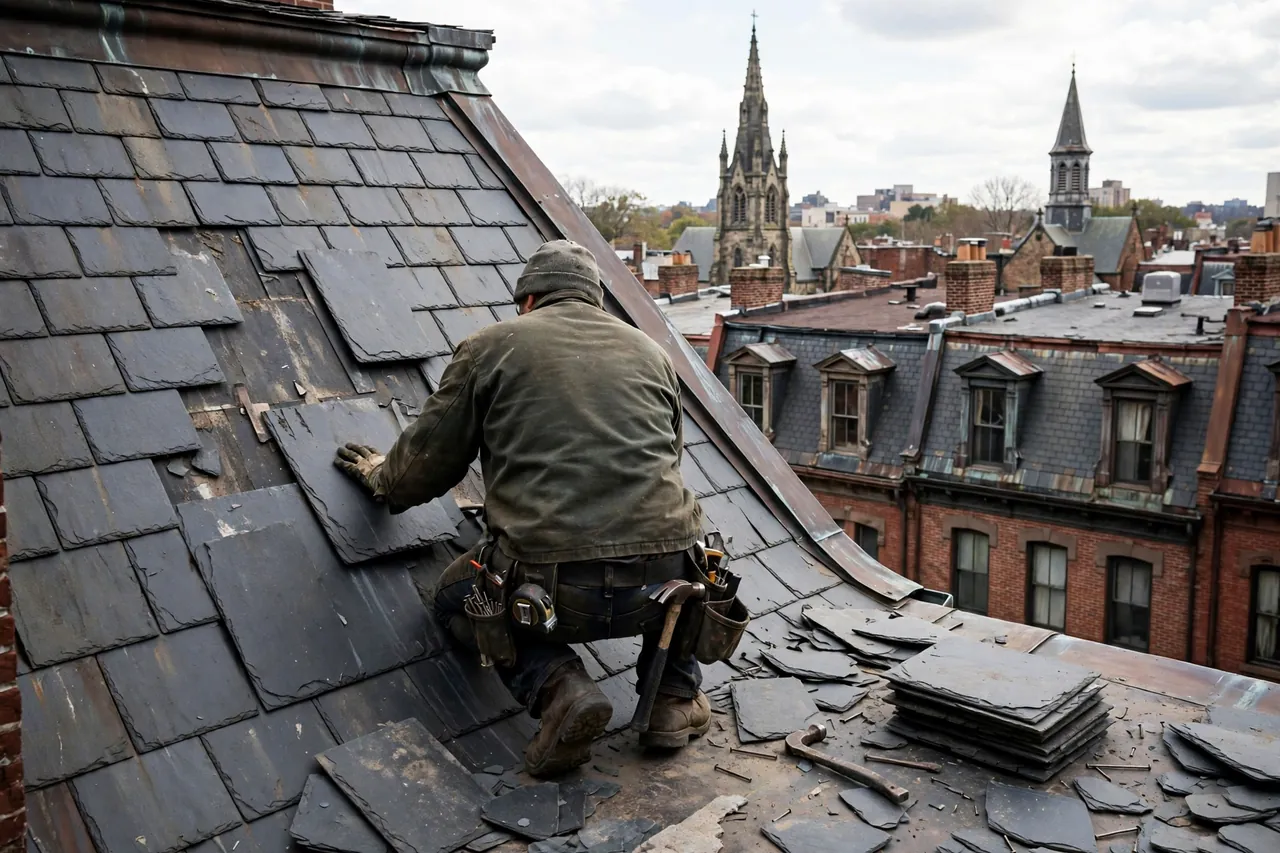
Slate is the neighborhood's original roofing, and it fails the way slate always fails — gracefully, one tile at a time. Freeze-thaw cycles crack individual slates; the nails holding them corrode over a century and let tiles slip; the stone itself delaminates along natural cleavage planes. A Quaker Hill slate roof rarely needs wholesale work — it needs a roofer who can source matching slate, weave replacement tiles in with copper or stainless fasteners, and renew the flashing without disturbing the sound courses around the damage. What slate roofs truly need is flashing maintenance, because the metal valleys, step flashing, and cornice flashings wear out decades before the stone does.
The bracketed cornices are a Quaker Hill signature — and a roofing detail. Italianate rowhouses carry deep bracketed cornices at the eaves, often with built-in gutters integrated into the cornice itself. These built-in systems are historically correct and beautiful, but their linings corrode and their downspout connections clog; water spilling over the cornice stains the brick below and rots the wood it was meant to protect. We repair these by relining with compatible metal and restoring proper fall — preserving the cornice profile instead of bolting on modern gutters that would change the look of a National Register-listed streetscape.
Mixed social history shows in the roofs. Quaker Hill is unusual among historic districts: 19th-century houses of all classes stand side by side — grand three-story rowhouses beside modest working-class homes — because the neighborhood grew organically rather than as a single development. That means a single block can hold a slate mansard, a standing-seam metal roof, and an asphalt-shingle slope, each with its own repair logic. Metal roofs need compatible-metal fastener work and seam resealing, never mixed metals that invite galvanic corrosion; shingle slopes need the standard shingle repair approach — damaged courses, renewed boots and flashings. We match the repair to what's actually on the roof.
Preservation awareness isn't optional here — it's the job. The district has been on the National Register since 1979, and its 19th-century streetscape is exactly what the listing protects. Our practice on Quaker Hill is repair-first and material-appropriate: match existing slate with slate, keep metal profiles consistent, choose shingle colors that suit the period of the house, and fix what has failed without disturbing the sound historic fabric around it. Before any work begins, careful leak detection — attic inspection, water-path tracing — makes sure we're repairing the true entry point, because on a 150-year-old roof, the stain and the source are rarely in the same place.
Common local problems
Common Roof Types and Problems in Quaker Hill
Quaker Hill's roofs span the 19th century's architectural range. Here is what we most often repair — and how each roof type tends to fail.
Slate mansard roofs
The Second Empire signature: steep slate lower slopes with dormers. Individual slates crack from freeze-thaw, slip as century-old nails corrode, or delaminate — while the flashing at dormers, the cornice line, and the flat deck behind the mansard fails decades earlier. We replace slipped and broken slates with matching stone on copper or stainless fasteners and renew the transition flashing without disturbing sound courses.
Bracketed cornices with built-in gutters
Italianate rowhouses carry deep bracketed cornices, often with gutters built into the cornice itself. Linings corrode, downspout connections clog, and water spills over the cornice — staining brick and rotting the woodwork. We reline these systems with compatible metal and restore proper fall, preserving the cornice profile. See our gutter repair approach for historic drainage.
Standing-seam metal roofing
Metal appears on Quaker Hill roofs as full coverings and as accents over bays and dormers. Panels last for generations, but fasteners back out, washers dry-rot, and hand-crimped seams open over the decades. We reseat and replace fasteners with compatible metals, reseal seams, and patch isolated corrosion — never mixing incompatible metals.
Architectural shingle slopes
Houses that lost their original slate or metal to 20th-century re-roofing now wear architectural asphalt shingles. Wind-lifted tabs on exposed ridges, granule erosion on south slopes, cracked sealant strips, and deteriorated pipe boots are the familiar failures. Targeted shingle repair — damaged courses, renewed boots and flashings — keeps these slopes going.
Chimney flashing on 1800s stacks
Quaker Hill's brick chimneys are among the oldest in the city — mortar eroded, step flashing long past its life, crowns cracked. Chimney leaks travel, so the stain often appears far from the stack. We repoint failing mortar, install new step and counter flashing, and seal the crown: the full chimney flashing repair, not a surface patch.
Flat decks behind the mansards
Behind every steep mansard slope sits a flat or low-slope deck — the part of the roof nobody sees from the street, and the part that ponds. Membrane seams, clogged interior drains, and flashing failure where the deck meets the mansard are the hidden leak pattern. We repair these with membrane patches and rebuilt flashing, the same approach as our flat roof repair.
Common in this area
Common Roof Repair Scenarios in Quaker Hill
These are the jobs we see again and again on Quaker Hill streets — described as patterns, not anyone's story.
Slipped slates on a mansard slope
Symptom: Dark slates have slid out of place on the steep mansard, with one or two visible in the gutter below — and a damp spot growing on the top-floor ceiling behind the slope. Typical fix: Replace the slipped and broken slates with matching stone on copper bibs or stainless hooks, and renew the flashing at the dormers and cornice line above the slipped area — the usual companion failure.
Cornice gutter overflowing
Symptom: Water pours over the bracketed cornice during heavy rain, staining the brick facade below — the built-in gutter's lining has corroded through. Typical fix: Reline the built-in gutter with compatible metal, restore fall toward the downspouts, and clear and reseal the downspout connections — keeping the historic cornice profile intact.
Hidden leak on the flat deck behind the mansard
Symptom: A stain spreads on a top-floor ceiling, but the visible slate slope looks sound — the water is entering at the flat deck hidden behind the mansard. Typical fix: Trace the water path to the deck, patch the membrane, renew the flashing where the deck meets the mansard slope, and clear the deck drainage.
We know the route
Landmarks Near Quaker Hill
Quaker Hill's landmarks are the reason the district exists — we navigate by the same history.
The Friends Meetinghouse
The 1816 meetinghouse at Fourth and West Streets — the third on a site Quakers have used since 1738 — anchors the district. Its own historic roof shows the same slate-and-flashing craft found on the surrounding rowhouses.
St. Peter's Cathedral
The 1816 cathedral and rectory stand among the district's oldest institutional buildings. Large-scale historic roofing done right — a useful reference for the preservation-minded repair work we do on neighboring residences.
Union Methodist Church
Set behind the rowhouses of West Fifth Street, the church's steep historic roof carries the same slate, flashing, and cornice details as the homes around it — period-correct construction at institutional scale.
New Mount Bethel Baptist Church
Occupying what were once four brick rowhouses with a continuous bracketed cornice, the church embodies Quaker Hill's layered history — residential fabric adapted and preserved, the same spirit as repair-first roofing.
Plan for the season
How Seasons Affect Roof Repair in Quaker Hill
Delaware's four-season climate works every weakness in a 150-year-old roof. Here is how the year typically plays out in Quaker Hill.
Spring
Nor'easters and heavy April rains test every mansard flashing, cornice gutter, and dormer valley in the district. Spring is the right time to assess winter's damage — slipped slates, opened flashing seams, clogged built-in gutters — before summer storm season.
Summer
Heat and humidity accelerate shingle aging and dry out sealants around flashings and pipe boots. Afternoon thunderstorms bring the year's strongest gusts, which exploit the steep mansard slopes like sails — loose slates and tabs go first.
Fall
Leaves pack into built-in cornice gutters, dormer valleys, and the flat decks behind the mansards. On these old roofs, one clogged gutter backs water into the cornice woodwork. A fall clearing keeps water moving off the roof before freeze-thaw season begins.
Winter
Freeze-thaw cycles pry at slate tiles, mortar joints, and flashing seams — the classic enemies of 19th-century roofing. Ice dams can form where heat escapes into old attics, backing water under the courses at the eaves and behind the mansard's lower edge.
Services available in Quaker Hill
Our Roof Repair Services in Quaker Hill
Every service below is available in Quaker Hill, tuned to the district's 19th-century housing stock. See all of our roof repair services, or learn more about our team.
01
Emergency Roof Repair
Storm damage on a 150-year-old roof can't wait. Our emergency response in Quaker Hill covers wind-torn slates and shingles, slipped mansard tiles, and active leaks — stabilized fast, then repaired properly.
View service 02Roof Leak Repair
Most Quaker Hill leaks start at flashing: mansard dormers, cornice lines, flat decks, and chimneys. We trace the water to its true entry point and repair it at the source.
View service 03Shingle Roof Repair
For the Quaker Hill homes now roofed in architectural shingles, we replace damaged courses, renew pipe boots and flashings, and match existing shingle profiles to the period of the house.
View service 04Metal Roof Repair
Standing-seam accents and full metal roofs on Quaker Hill homes get compatible-metal fastener work, seam resealing, and isolated corrosion patches — never mixed metals.
View service 05Chimney Flashing Repair
The district's 1800s brick stacks are classic leak sources: eroded mortar, failed step flashing, tired crowns. We repoint, re-flash, and seal so the stack stops feeding water into the attic.
View serviceWhere we work
One local team. A lot of ground covered.
Downtown WilmingtonHistoric DistrictTrolley SquareHighlandsBaynard VillageRiverfrontForty AcresBrandywine VillageCool SpringHedgevilleHilltopThe FlatsNorthwest WilmingtonQuaker Hill
Check my address Most slate mansards can be repaired. Individual cracked or slipped slates are replaced with matching stone, and the flashing — which usually fails first — is renewed. Broader work is only worth discussing when the slate itself is widely delaminating or fasteners are failing across whole slopes, which a professional assessment can determine.
Proper repair should not. We match existing materials — slate for slate, compatible metal for metal — and keep profiles, colors, and cornice details consistent with the house and the district. The goal is a repair that disappears into the original roof.
Behind the steep mansard slope sits a flat or low-slope deck — invisible from the street. It ponds, its membrane seams age, and its drains clog; the flashing where the deck meets the mansard is the hidden leak point on many Quaker Hill homes. We repair it with membrane patches and rebuilt flashing.
Water spilling over the cornice during rain, staining on the brick below the eaves, and visible corrosion in the gutter channel all point to lining failure. Relining restores the system without changing the historic cornice.
They require proper staging, roof brackets, and fall protection — which is why steep historic roofs are not DIY territory. Professional crews plan access around the height, pitch, and the district's narrow streets before any work begins.
Once a year is a sound rhythm, ideally in spring after winter's freeze-thaw cycles, plus an inspection after any major nor'easter or windstorm. Catching a slipped slate or failed flashing early keeps a small repair small — and preservation-minded.
Yes — standing-seam panels and accents get compatible-metal fastener renewal, seam resealing, and isolated corrosion patches. We never mix incompatible metals, which accelerates galvanic corrosion and shortens the repair's life.
Your next step is waiting
Mansard Slipping Slates? Let's Look.
Quaker Hill roofs are the oldest in the city, and they reward the most careful work. Call The Roof Medics for an honest, preservation-minded assessment of your slate, metal, or shingle roof — we'll show you exactly what needs repair and what can wait.
Start with the basics
Contact Us for Roof Repair
Reach out to us for any roof repair needs. We are available Monday to Friday and respond quickly to inquiries.