Your local team · Hilltop
Roof Repair in Hilltop, Wilmington DE
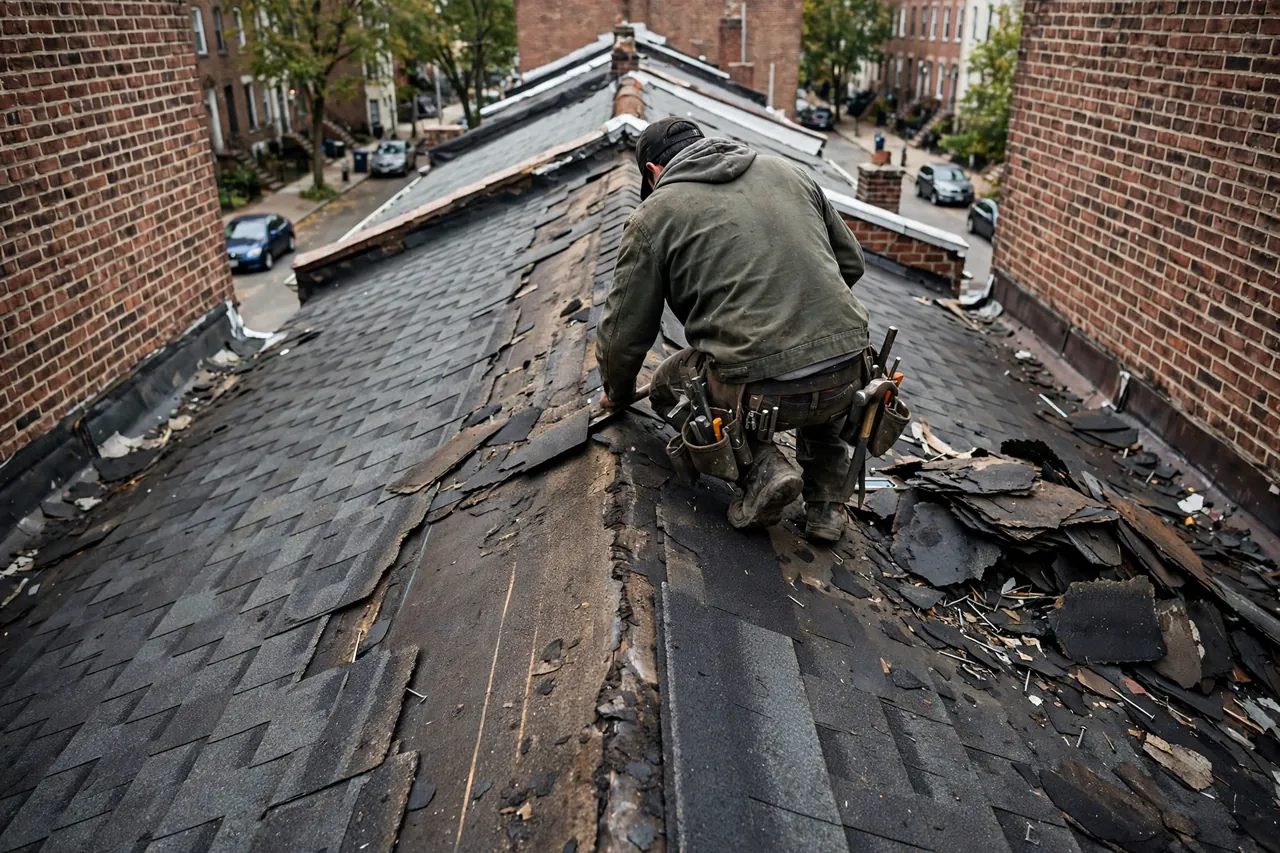
Roof repair in Hilltop, Wilmington DE means working on narrow attached brick rowhouses on the city's west side — 1900-era masonry homes with steep shingle fronts and low-slope rear sections, many of them mid-renovation as the neighborhood reinvests. The Roof Medics repairs shingle, membrane, and shared-plane roofs across Hilltop, from original-condition blocks to fully renovated homes. If your roof is leaking or your renovation has exposed roof problems, contact our team or call (302) 445-8567.
Local knowledge
Why Roof Repair in Hilltop Is Different
Hilltop sits on Wilmington's west side — north of Hedgeville and Browntown, south of Little Italy — and its housing stock is classic early-1900s working-class Wilmington: narrow attached brick rowhouses, masonry walls, steep shingle fronts, and low-slope rear sections. Many of these homes were built around 1900 and are now in the middle of a renovation wave that is rebuilding the neighborhood roof by roof.
The defining reality of a Hilltop roof is the mix of old and new on a shared plane. Renovation has been transforming these blocks — homes stripped to the studs, old layers torn off to the deck, new shingles and membrane going on — while the houses on either side keep their original roofs. The result is a continuous attached plane where a 2024 shingle section sits directly beside a 1980s one, and the flashing where they meet is the most important detail on the block. When we inspect a Hilltop roof, we read that boundary first: how the new section ties into the old, whether the shared flashing was renewed or just caulked over, and where the water goes when the two eras meet.
The original Hilltop rowhouse roof is a study in practical 1900s construction. Narrow lots mean narrow roofs — steep front slopes in asphalt shingles (replacing the original slate or wood long ago), party walls between neighbors, and a shallow rear section over the kitchen in rolled roofing or modified bitumen. The front slope fails like any aging shingle roof: wind-lifted tabs on the exposed edges, granule loss on the south slopes, cracked sealant strips, tired pipe boots. The rear section fails like a flat roof: ponding, seam failures, and flashing breakdown at the house wall. Most Hilltop leak calls are about that rear half — it's the part of the house nobody looks at until the kitchen ceiling stains.
Renovation changes the repair conversation. A home that has been “renovated from roof to basement” may have a brand-new roof — but new work still needs its first real inspection after a few storm seasons: flashing details settle, sealants cure and shrink, and the tie-in to the neighbor's original section gets its first real test in a nor'easter. And a home mid-renovation is the best possible time to fix the roof, while the structure is open and the deck is accessible. We work with Hilltop homeowners and their contractors at both stages — verifying new work and repairing what the renovation uncovered — so the finished home doesn't inherit the old roof's problems.
Shared planes and party walls run through every Hilltop block. Water doesn't respect renovation boundaries: a leak that enters at a tired flashing run on an original-condition house can travel along the shared decking and appear in the renovated home next door — a frustrating surprise after a six-figure renovation. Our practice is to map the full shared plane, document where each section stands, and make flashing repairs continuous across the boundary. When a stain's source turns out to be two doors down, careful leak detection — attic inspection, water-path tracing — finds it without tearing into the wrong roof.
The neighborhood's mature trees and narrow streets shape maintenance too. Hilltop's canopy shades north-facing slopes, keeping shingles damp and encouraging moss, and fall leaves pack into valleys and gutters — on a shared plane, one clogged section backs water up across a property line. A yearly clearing and a spring roof inspection after winter's freeze-thaw cycles catch the lifted tabs and stressed flashing before the next storm season. It's the simplest preventive work a roof gets — and on attached housing, it protects the neighbors too.
Common local problems
Common Roof Types and Problems in Hilltop
Hilltop's roofs are early-1900s attached construction, now half-original and half-renovated. Here is what we most often repair — and how each roof type tends to fail.
Narrow attached shingle fronts
The steep front slopes of Hilltop rowhouses mostly wear architectural asphalt shingles — original-condition homes carry older layers, renovated homes carry new ones. Wind-lifted tabs along exposed edges, granule erosion, cracked sealant strips, and deteriorated pipe boots are the familiar failures. Targeted shingle repair — damaged courses replaced, boots and flashings renewed — keeps both eras of roof going.
Mixed-era shared planes
Where a renovated home's new roof meets the neighbor's original section, the tie-in flashing is the block's most failure-prone detail. Different eras, different materials, different settling — and one seam where they meet. We rebuild these transitions with continuous new flashing that bridges both sections instead of patching over the joint.
Low-slope rear kitchen roofs
The shallow rear sections over Hilltop kitchens are roofed in rolled roofing or modified bitumen, and they pond. Decades of settling flatten them further; clogged drainage finishes the job. Ponding water, cracked seams, and flashing failure at the house wall are the neighborhood's top leak pattern — repaired with membrane patches and rebuilt drainage.
Party-wall flashing
Older Hilltop blocks carry party walls rising through the roof plane, and the flashing along both sides of the wall wears out as water splits off the plane. Mortar erosion at the wall base opens gaps that channel water into the structure. We repoint failing mortar and install new step and counter flashing so the wall sheds water cleanly on both sides.
Porch roofs and fascia
Covered front porches sit under shallow roofs that catch the main slope's runoff, and the wall flashing where porch meets house works harder than anywhere on the building. Failed flashing, clogged porch gutters, and rotted fascia are constant calls. We repair the membrane, rebuild the flashing, and pair it with soffit and fascia repair where the wood has rotted.
Chimney flashing on brick stacks
Hilltop's tall brick chimneys are classic leak sources: eroded mortar, failed step flashing woven into the shingle courses, tired crowns. The fix is methodical — repoint, re-flash, seal the crown — and it stops one of the most misdiagnosed leaks in attached housing. See our chimney flashing repair for the full approach.
Common in this area
Common Roof Repair Scenarios in Hilltop
These are the jobs we see again and again on Hilltop streets — described as patterns, not anyone's story.
Leak at the renovated-to-original tie-in
Symptom: The renovated home's new roof looks perfect, but water stains appear on an upstairs ceiling after heavy rain — entering at the flashing seam where the new section meets the neighbor's original roof. Typical fix: Strip the joint, install continuous new flashing bridging both sections, and seal the transition so the two eras shed water as one plane.
Rear kitchen roof ponding
Symptom: Water stands for days on the shallow roof over the rear kitchen, and a damp spot grows on the ceiling near the house wall. Typical fix: Rebuild the drainage path, patch the membrane with an adhered or heat-welded repair, and renew the counter flashing where the rear roof meets the main house wall.
Post-renovation first-storm check
Symptom: A home was renovated a year or two ago, and the owner wants the new roof verified before the next nor'easter — flashing details settle and sealants shrink in the first seasons. Typical fix: A full inspection of the new work and the tie-ins to neighboring original sections, with any settling flashing re-sealed and minor issues corrected while they're still minor.
We know the route
Landmarks Near Hilltop
Hilltop's landmarks are the institutions its residents live around — we navigate by the same streets.
The Latin American Community Center
A Hilltop anchor for decades, drawing the neighborhood's Latino community and marking the area's modern identity. The rowhouses around it — some of the oldest on the west side — carry the original-condition roofs we know best.
The Fourth Street corridor
Hilltop's commercial spine, where attached rowhouses meet storefronts. The mixed-use buildings here carry flat and low-slope roofs that need the same membrane care as residential rear sections — see our commercial roof repair.
Pleasant Street's renovated rowhouses
Blocks like the 1100 block of Pleasant Street show Hilltop's renovation wave in full: 1900-era masonry rowhouses rebuilt inside historic walls, with new roofs beside original ones — the mixed-era shared planes we specialize in reading.
Saint Francis Hospital
Just east of the neighborhood, the hospital campus is the area's biggest institutional landmark. Its large-scale roofing is a world away from rowhouses — but the flashing principles are the same ones we apply at residential scale.
Plan for the season
How Seasons Affect Roof Repair in Hilltop
Delaware's four-season climate works every weakness in attached 1900s housing. Here is how the year typically plays out in Hilltop.
Spring
Nor'easters and heavy April rains test every mixed-era tie-in, shared flashing run, and rear roof on the block. Spring is the right time to assess winter's damage — lifted tabs, ponding that worsened on rear sections, stressed flashing at renovation tie-ins — before summer storm season.
Summer
Heat and humidity accelerate shingle aging and dry out sealants around flashings and pipe boots. Afternoon thunderstorms bring the year's strongest gusts, which find loose tabs on exposed front slopes first — and the low-slope rear sections bake, stressing old membrane seams.
Fall
Street trees drop leaves into valleys, gutters, and the low spots behind dormers. On a shared plane, one clogged section backs water up across a property line. A fall clearing keeps water moving off the whole run before freeze-thaw season begins.
Winter
Freeze-thaw cycles pry at flashing seams, mortar joints, and membrane patches — including the sealants on recently renovated sections, which are still curing through their first winters. Ice dams can form where heat escapes into old attics, backing water under the courses at the eaves.
Services available in Hilltop
Our Roof Repair Services in Hilltop
Every service below is available in Hilltop, tuned to the neighborhood's attached rowhouses — original, renovated, and everything between. See all of our roof repair services, or learn more about our team.
01
Shingle Roof Repair
For Hilltop's steep front slopes — old layers and new — we replace damaged courses, renew pipe boots and flashings, and match existing shingle profiles so the repair blends into the block.
View service 02Flat Roof Repair
Rear kitchen roofs, porch roofs, and low-slope additions get membrane repairs — adhered or heat-welded patches — with rebuilt wall flashing where the shallow section meets the house.
View service 03Roof Leak Repair
Most Hilltop leaks start at flashing: mixed-era tie-ins, party walls, rear roof-to-wall transitions, and chimneys. We trace the water to its true entry point and repair it at the source.
View service 04Soffit & Fascia Repair
Rotted fascia at porch edges and eaves is common on 1900-era rowhouses — and gutters need solid wood to hang from. We renew the rotted boards so the drainage system has something sound to attach to.
View service 05Emergency Roof Repair
Storm damage on a shared attached roof can't wait. Our emergency response in Hilltop covers wind-torn shingles, slipped sections, and active leaks — stabilized fast, then repaired properly.
View serviceWhere we work
One local team. A lot of ground covered.
Downtown WilmingtonHistoric DistrictTrolley SquareHighlandsBaynard VillageRiverfrontForty AcresBrandywine VillageCool SpringHedgevilleHilltopThe FlatsNorthwest WilmingtonQuaker Hill
Check my address Yes, after its first few storm seasons. Flashing details settle, sealants cure and shrink, and the tie-in to your neighbor's original section gets its first real test in a nor'easter. A verification inspection catches settling issues while they're still minor.
It's the seam where a renovated home's new roof meets the neighbor's original section — different materials, different settling, one joint. Water exploits any gap there. We rebuild these transitions with continuous new flashing that bridges both sections instead of patching over the joint.
Yes — mid-renovation is actually the best time to fix the roof, while the structure is open and the deck is accessible. We coordinate with your contractor so the roofing work fits the renovation schedule instead of fighting it.
It can be. Disturbing a shared plane — stripping one half, re-flashing the tie-in — can redirect water onto the neighboring section. We inspect the full shared run and the tie-in flashing to find out, then repair the actual entry point.
Rear sections are shallow-pitched, so water moves slowly and ponds; the flashing where the rear roof meets the main house wall takes constant abuse. It's the most leak-prone part of nearly every Hilltop rowhouse — and it's repaired with membrane patches and rebuilt flashing.
Once a year, ideally in spring after winter's freeze-thaw cycles, plus after any major nor'easter or windstorm. On a shared plane — especially a mixed-era one — early detection keeps a small flashing failure from becoming a multi-owner problem.
Yes. With so many Hilltop homes changing hands mid-renovation, a pre-purchase inspection tells the buyer exactly which roof sections are sound, which need repair, and how the shared plane stands — before the first winter, not after it.
Your next step is waiting
Renovating — or Living Beside One? Let's Look.
Hilltop roofs are a mix of original and new, and the seams between the two are where trouble starts. Call The Roof Medics for an honest assessment: we'll read the whole shared plane, verify new work, and repair what's actually broken.
Start with the basics
Contact Us for Roof Repair
Reach out to us for any roof repair needs. We are available Monday to Friday and respond quickly to inquiries.