Your local team · The Flats
Roof Repair in The Flats, Wilmington DE
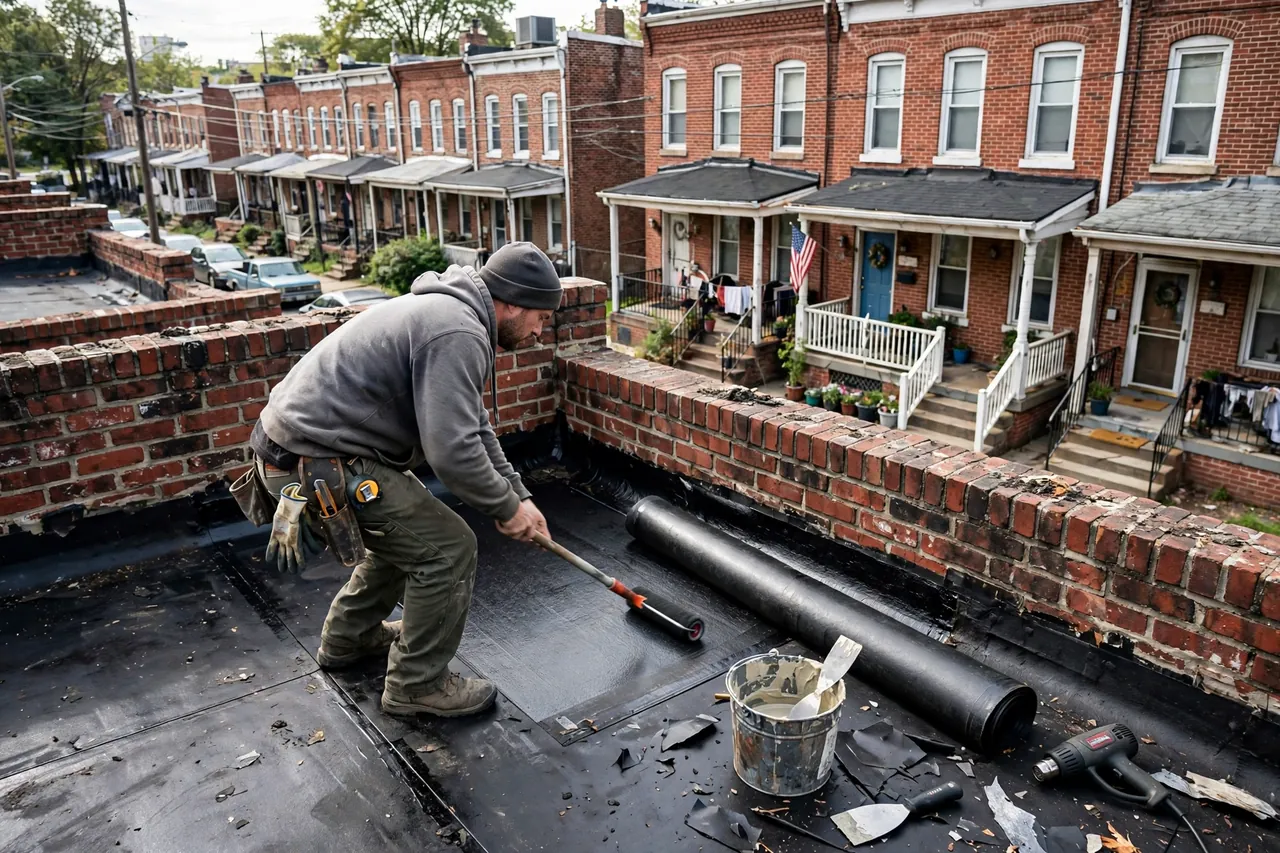
Roof repair in The Flats, Wilmington DE means working on a one-of-a-kind neighborhood — the 1901 working-class rowhouses built by William Bancroft's Woodlawn Company, now being redeveloped block by block into new homes that keep the historic brick-and-porch character. The Roof Medics repairs original and redeveloped roofs across The Flats, from century-old flat sections to new membrane systems. If your roof is leaking or ponding, contact our team or call (302) 445-8567.
Local knowledge
Why Roof Repair in The Flats Is Different
The Flats is unlike any other Wilmington neighborhood. In 1901, businessman William Bancroft developed it through the Woodlawn Company — now the Woodlawn Trustees — as modestly priced homes for the city's working-class residents: red-brick rowhouses with front porches, built plainly and well. More than a century later, Woodlawn is redeveloping those same blocks in phases, replacing functionally obsolete originals with new homes that keep the brick-and-porch character.
The defining feature of a Flats roof is its origin story. The 1901 rowhouses were built for economy, not longevity of roofing: flat or very shallow roof sections, minimal insulation, simple construction. Over a century of Delaware weather, those roofs have been patched, coated, and re-roofed many times — layers of rolled roofing and membrane over the original decking, each layer hiding the sins of the last. When we inspect an original Flats roof, we read it like an archive: which layers are sound, which are trapping moisture between them, and where the decking underneath has softened. Repairing here means fixing the leak without disturbing the layers that are still working — surgical membrane work on a roof that has seen a century of patches.
The redevelopment adds a second roof type to the neighborhood. Since 2015, Woodlawn — with partners including the Todmorden Foundation and HDC MidAtlantic — has been rebuilding The Flats in phases: new apartment buildings and new rowhouses with private entrances, all with modern roofing systems, insulation, and drainage. These new roofs are straightforward to maintain — but they still need their first real inspections after a few storm seasons, and the blocks where new construction meets original rowhouses create transitions that deserve a careful eye. We service both: the originals with repair-first care, and the new phases with verification and maintenance.
Flat and low-slope construction dominates both eras. The original Flats rowhouses carry flat or nearly flat roof sections behind their parapets; the new phases carry modern low-slope systems. Flat roofs fail in their own ways: ponding water where drainage has settled, seam failures in aging membrane, punctures and blisters, clogged scuppers and drains. Our flat roof repair approach — adhered or heat-welded membrane patches, rebuilt drainage, renewed flashing at parapets — is built exactly for this construction, old and new alike.
Parapet walls and shared planes shape the repair work. The Flats' rowhouses present brick parapets to the street, with the roof membrane turning up behind them — and the membrane-to-parapet flashing is the highest-maintenance detail on the building. On original blocks, a century of re-pointing and patching has left these transitions layered and fragile; on new phases, they're clean but young. We renew parapet flashing with materials matched to the era of the building, and where party walls divide attached homes, we make the repair continuous across the boundary — because water on a shared plane doesn't stop at a property line.
Ventilation and moisture are the quiet story of The Flats. The original rowhouses were built without insulation — generations of residents paid to heat the bricks, as Woodlawn's own history of the neighborhood notes — which means a century of heat and moisture moving through these roof assemblies. Trapped moisture between old roofing layers softens decking and feeds the leaks that look like flashing failures but are really assembly failures. When we find that pattern, we say so plainly: some Flats roofs need more than a patch, and an honest assessment — see our roof ventilation repair and inspection approach — is how you find out before the ceiling tells you.
Common local problems
Common Roof Types and Problems in The Flats
The Flats' roofs span 1901 originals to brand-new redevelopment phases. Here is what we most often repair — and how each roof type tends to fail.
Original 1901 flat roof sections
The century-old flat sections behind the parapets carry layers of rolled roofing and membrane over original decking. Trapped moisture between layers, softened decking, ponding where the structure has settled, and tired flashing at the parapets are the pattern. We repair these surgically — membrane patches that fix the leak without disturbing the sound layers around it.
Parapet flashing transitions
Where the roof membrane turns up behind the brick parapet is the most failure-prone detail on a Flats rowhouse. A century of patching has left original transitions layered and fragile; coping stones shift, mortar erodes, and water gets behind the flashing. We rebuild these transitions with new flashing matched to the building's era, sealed to the parapet properly.
New-phase low-slope systems
The redeveloped blocks carry modern low-slope roofing — clean, insulated, well-drained — but young. Settlement, construction debris in drains, and first-storm flashing tests are the early issues. We verify new-phase roofs after their first storm seasons and keep their drainage clear so the new systems age the way they were designed to.
Ponding and drainage failures
Flat roofs live or die by drainage. On original sections, decades of settling have flattened the falls toward scuppers and drains; on any flat roof, a single clogged scupper turns a rain event into a pond. We rebuild drainage paths, clear and renew scuppers, and patch the membrane where ponding has stressed it — fixing the water's exit, not just the spot where it sits.
Shared-plane rowhouse roofs
The Flats' attached rowhouses share continuous roof planes divided by party walls. Water travels along shared decking and behind shared flashing until it finds a ceiling — sometimes doors from its entry point. We map the full shared run and make flashing repairs continuous across boundaries, with leak detection — attic inspection, water-path tracing — when the stain and the source don't line up.
Porch roofs and rear sections
Front porches and rear additions carry shallow roofs that catch the main roof's runoff, and the wall flashing where they meet the house works hardest. Failed flashing, clogged porch drainage, and rotted fascia are steady calls. We patch the membrane, rebuild the flashing, and renew rotted wood with soffit and fascia repair so the new drainage has solid wood to hang from.
Common in this area
Common Roof Repair Scenarios in The Flats
These are the jobs we see again and again in The Flats — described as patterns, not anyone's story.
Parapet flashing failure on an original rowhouse
Symptom: Water stains appear on the top-floor ceiling near the front wall after wind-driven rain — the membrane-to-parapet flashing has opened behind the brick parapet. Typical fix: Rebuild the parapet flashing transition with new metal, repoint the eroded mortar at the parapet base, and verify the coping is shedding water outward instead of into the wall.
Ponding on a 1901 flat section
Symptom: Water stands for days on the flat roof behind the parapet, and a soft spot has developed in the ceiling below. Typical fix: Rebuild the drainage path to the scuppers, patch the membrane where ponding has stressed it, and probe the decking — on century-old sections, trapped moisture between layers may mean the repair needs to go deeper than a surface patch.
First-storm check on a new-phase roof
Symptom: A redeveloped home or building has been through its first few storm seasons, and the owner wants the new roofing verified — settlement and debris in drains are the early issues on new low-slope systems. Typical fix: A full inspection of the membrane, flashing, and drainage, clearing any construction debris from scuppers and correcting minor settling issues while they're still minor.
We know the route
Landmarks Near The Flats
The Flats' landmarks tell the neighborhood's unusual story — we navigate by the same history.
The original 1901 Flats rowhouses
William Bancroft's Woodlawn Company built these red-brick rowhouses with front porches as modestly priced homes for working families — a purpose-built working-class neighborhood, rare in its completeness. The surviving originals are the roofs we read like archives.
The Woodlawn Library
The neighborhood's library anchors community life in The Flats. The blocks around it hold a mix of original and redeveloped rowhouses — the full span of Flats roof types on a few streets.
The Seventh Street and Bayard Avenue redevelopment site
Where the newest phase of the Woodlawn redevelopment is rising. New construction beside original blocks creates the transitions we watch most carefully — new flashing meeting century-old walls.
Union Street
The retail and dining corridor serving The Flats, where rowhouses meet storefronts. The mixed-use buildings here carry the same flat and low-slope systems as the residential blocks — see our commercial roof repair service.
Plan for the season
How Seasons Affect Roof Repair in The Flats
Delaware's four-season climate works every weakness in flat and low-slope construction. Here is how the year typically plays out in The Flats.
Spring
Nor'easters and heavy April rains test every parapet flashing, scupper, and membrane seam in the neighborhood. Spring is the right time to assess winter's damage — ponding that worsened, flashing opened by freeze-thaw, drains clogged with winter debris — before summer storm season.
Summer
Heat bakes flat membranes and stresses old seams; afternoon thunderstorms dump water faster than settled drainage can move it. Summer is when ponding problems announce themselves — and when new-phase roofs get their first real drainage test.
Fall
Leaves pack into scuppers, drains, and the low spots behind parapets. On a flat roof, one clogged scupper turns a rain event into a pond that sits for days. A fall clearing keeps water moving off the roof before freeze-thaw season begins.
Winter
Freeze-thaw cycles pry at parapet flashing, coping mortar, and membrane seams. Ponded water that freezes and thaws works at every weak point — and on the original 1901 sections, winter is when trapped moisture between old layers does its quiet damage.
Services available in The Flats
Our Roof Repair Services in The Flats
Every service below is available in The Flats, tuned to the neighborhood's flat and low-slope rowhouses — 1901 originals and new phases alike. See all of our roof repair services, or learn more about our team.
01
Flat Roof Repair
The Flats' flat and low-slope sections get membrane repairs — adhered or heat-welded patches — with rebuilt drainage and renewed parapet flashing. Old originals and new phases alike.
View service 02Roof Leak Repair
Most Flats leaks start at parapet flashings, scuppers, or shared-plane transitions. We trace the water to its true entry point — even when it's doors down the row — and repair it at the source.
View service 03Roof Ventilation Repair
A century of heat and moisture moving through uninsulated 1901 roof assemblies leaves its mark. We repair ventilation and airflow issues that trap moisture between old roofing layers.
View service 04Gutter Repair
Scuppers, drains, and gutter runs on flat roofs are the drainage system — when they clog or fail, the roof ponds. We clear, re-pitch, and renew them so water leaves the roof.
View service 05Roof Inspection
Original, redeveloped, or somewhere between — an inspection maps the layers, the drainage, the parapets, and the shared planes, so you know exactly what needs repair and what can wait.
View serviceWhere we work
One local team. A lot of ground covered.
Downtown WilmingtonHistoric DistrictTrolley SquareHighlandsBaynard VillageRiverfrontForty AcresBrandywine VillageCool SpringHedgevilleHilltopThe FlatsNorthwest WilmingtonQuaker Hill
Check my address Often, yes — many original Flats roofs have sound structure under their layers, and surgical membrane patches plus rebuilt parapet flashing fix the leak without disturbing what's working. But a century of layered patches sometimes hides trapped moisture and softened decking, and an honest inspection will tell you when repair is still the right call.
The membrane turns up behind the brick parapet — a transition that moves with every temperature swing while the brick stays put. A century of that movement, plus eroded mortar and shifted coping stones, opens the joint. Rebuilding it with new flashing sealed properly to the parapet is the lasting fix.
Flat roofs are built with slight falls toward drains and scuppers, but decades of settling flatten those falls — and one clogged scupper stops the whole system. We rebuild the drainage path and renew the scuppers so water has somewhere to go.
Yes — new roofs are young, not immortal. Settlement, construction debris in drains, and first-storm flashing tests are the early issues. A verification inspection after the first few storm seasons catches them while they're minor.
On a shared rowhouse plane, water travels. We trace the water path through attic inspection and testing to find the true entry point — even doors down the row — then repair the failed flashing where it actually is, coordinating across the boundary.
Proper repair should not. The brick parapets and front porches that define The Flats stay untouched — membrane and flashing work happens behind the parapet, invisible from the street. The goal is a repair that disappears.
Once a year, ideally in spring after winter's freeze-thaw cycles, plus after any major nor'easter or windstorm. On flat construction — original or new — early detection keeps a drainage problem from becoming a decking problem.
Your next step is waiting
1901 Original or New Phase — Let's Look.
The Flats rewards roofers who read the building's history — the layers, the parapets, the phases. Call The Roof Medics for an honest assessment: we'll show you what's sound, what needs repair, and what the redevelopment means for your roof.
Start with the basics
Contact Us for Roof Repair
Reach out to us for any roof repair needs. We are available Monday to Friday and respond quickly to inquiries.