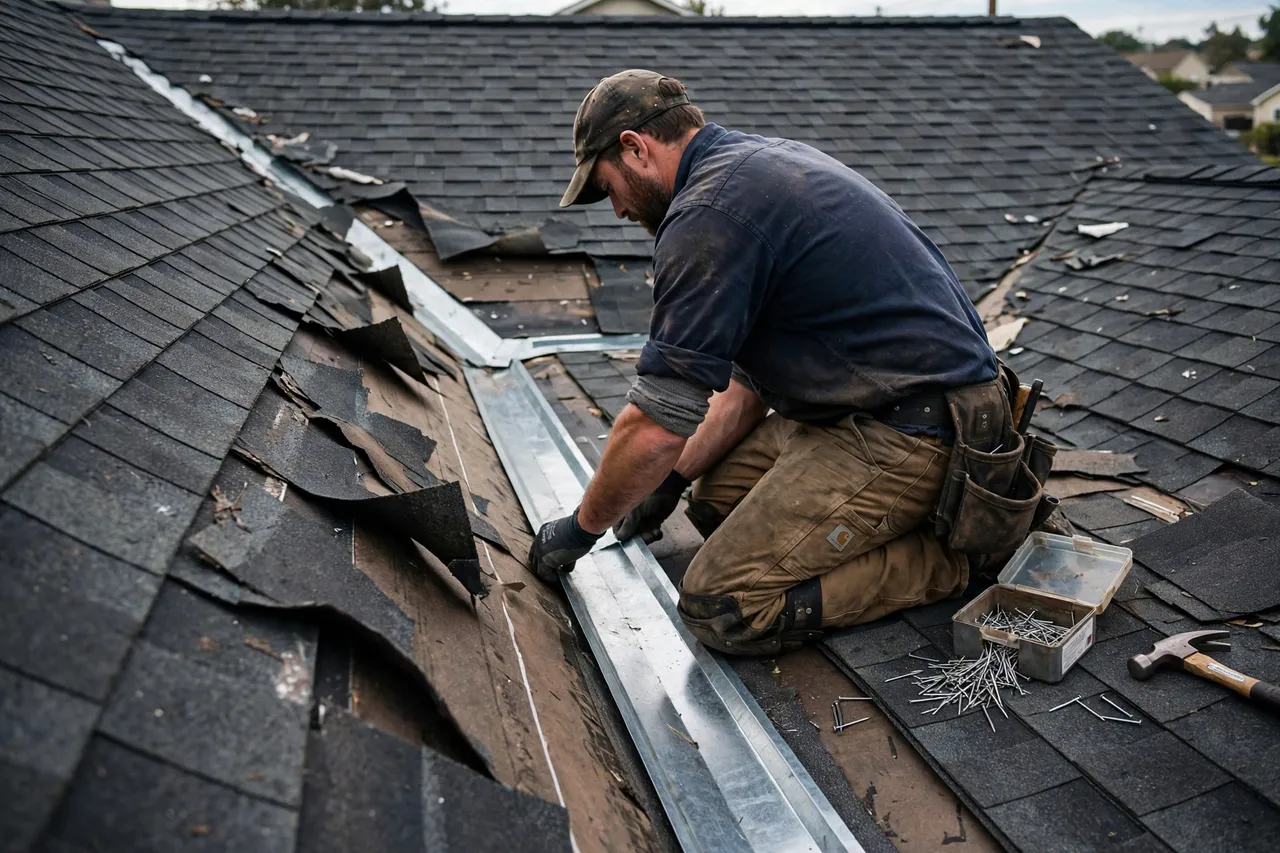
Roof Valley Repair
Roof Valley Repair in Wilmington DE
A roof valley carries more water than any other part of your roof — every drop that lands on two slopes funnels into that one channel. When the valley metal wears through, the underlayment beneath it fails, or debris dams the channel, water finds its way under the shingles and into the house. Our roof valley repair service in Wilmington, DE rebuilds the valley properly: fresh metal, fresh underlayment and shingles re-laid to shed water the way the valley was designed to.
Service overview
Why do roof valleys leak first?
A valley is where two roof slopes meet and every drop of rain from both planes converges. It handles a river in every storm — and it is the first place a roof shows its age.
Picture rain falling on a simple gable roof. Water landing on either slope runs downhill, and where the two slopes meet, the two streams join into one channel — the valley. In a heavy storm the valley carries a concentrated flow many times stronger than any flat stretch of shingle. That is why valleys are built with extra layers: a metal liner or heavy underlayment in the channel, and shingles cut or woven over it. When any layer wears out, the leak shows up there before anywhere else on the roof.
Valleys come in two main styles, and each fails in its own way. An open valley shows a strip of exposed metal down the channel, with shingles cut back on either side — clean-looking and easy to inspect, but the exposed metal takes the full force of the water and eventually wears, dents or corrodes. A closed valley hides the metal under shingles that are woven or cut across the channel — tidier to look at, but the shingle edges in the channel wear faster, debris catches on the cut lines, and the underlayment beneath does the real work unseen. Wilmington has both styles across its neighborhoods, and each needs its own repair approach.
Debris is the valley’s quiet enemy. Leaves, twigs and shingle granules collect in the channel, especially where trees overhang the roof — and Wilmington’s older streets are lined with them. A mat of wet leaves dams the channel, and the next rain ponds behind it, pushing water sideways under the shingle courses on both slopes. The cause is usually a dammed channel plus underlayment that has finally given way after seasons of standing water.
A valley repair is not a tube of sealant down the channel. Sealant washes out, cracks with temperature swings, and hides the real problem for a season before the leak returns worse than before. A proper repair opens the valley, removes the failed metal or underlayment, rebuilds the channel with fresh material, and re-lays the shingles so water runs cleanly down the center. It is the most hands-on repair on the roof — and the one where shortcuts fail fastest.
Practical benefits
Why a proper valley repair matters
The valley is the roof’s drainage highway. Here is what rebuilding it correctly protects.
Leaks that only happen in heavy rain, solved
A valley that handles light rain and fails in downpours is a valley whose channel is overwhelmed — worn metal, tired underlayment or a debris dam. Rebuilding the channel fixes the heavy-rain failure, not just the drizzle.
No more sealant cycles
Sealant in a valley lasts a season at best, then cracks and washes out — and each application hides the wear underneath a little longer. A rebuilt valley ends the reseal-and-wait cycle for good.
The decking underneath survives
A leaking valley soaks the decking beneath it, and valley decking rots faster than anywhere else on the roof because it stays wet longest. Repairing the valley now protects the structure under it.
A channel that clears itself
A correctly rebuilt valley has a clean, unobstructed channel with the right width and fall, so leaves and granules wash through instead of damming up.
How service works
Our roof valley repair process
From the first look down the channel to the last shingle re-laid — here is the valley repair sequence, step by step.
STEP 01
Channel inspection
We clear the valley of debris and inspect the full channel from ridge to eave — metal condition, shingle edges, underlayment exposure and any debris dams — plus the attic below for staining that shows where water has been crossing.
Tools and methods
Tools and methods for valley repair
Valley metal and underlayment
New valley metal — formed to sit flat in the channel — over a fresh layer of valley underlayment. The two layers work together: metal sheds the water, underlayment catches anything that gets past it.
Hook blade and shingle cutter
Shingles are cut back from the channel in a clean, straight line, so the valley edge is crisp and water stays in the metal instead of wicking under ragged shingle edges.
Chalk lines
The valley centerline is snapped from ridge to eave before the metal goes down, so the liner sits true — a liner that wanders off-center leaves one slope’s water running over bare underlayment.
Tin snips and hand seamer
Valley metal is cut and folded on site to fit the exact length and angle of the channel, including the eave kick that throws water clear of the fascia.
Leaf blower and gutter scoop
The channel and the gutters below it are cleared completely before the repair starts and again when it finishes.
Photo documentation
The channel is photographed at every stage: debris in place, metal removed, decking exposed, new liner fitted, shingles re-laid. You see what failed and what replaced it.
Where this service fits
When you need roof valley repair
The roof leaks only during heavy rain.
A valley that holds in light rain and fails in downpours is the classic valley failure: the channel is overwhelmed because the metal is worn, the underlayment is tired, or debris is damming the flow. Light-rain leaks point elsewhere; heavy-rain leaks point at the valley.
You can see rust, holes or lifted edges in the valley metal.
Exposed valley metal that has rusted through, dented or lifted at the edges is no longer shedding water — it is directing it under the shingles. Visible metal damage means the channel has already failed, even if the ceiling has not stained yet.
Leaves keep collecting in the same valley.
A valley that dams up every autumn has a channel too rough or too narrow from worn shingles and granule buildup. Clearing the leaves helps for a week; rebuilding the channel so debris washes through is the lasting fix.
Local execution
Valley repair across Wilmington’s neighborhoods
Wilmington’s roofs give each neighborhood its own valley pattern. Here is where the channels usually fail, area by area.
Trolley Square
Victorian roofs with multiple intersecting valleys and dormers: the channels are short, steep and numerous, and the old metal liners have been patched more than once. Valley work here matches the existing closed-valley style so the repair blends with the historic roofline.
Forty Acres
Long, straight valleys on broad brick colonials carry a heavy flow in every storm, and the open metal channels show wear first. The repair usually means a full-length new liner, not a patch, because the whole run has been carrying the same load.
Historic District
Original valley metal on some of the city’s oldest roofs, with shingles woven over channels that have shifted slightly as the houses settled. The repair respects the original style while rebuilding the channel underneath it.
The Highlands
Tree cover near Rockford Park drops leaves straight into the valleys, and the channels dam up every autumn. Valley repairs here include a channel profile that clears debris instead of trapping it, and a reminder to keep the valleys clear.
Quaker Hill
Steep slopes with tight valleys where water moves fast and granule loss concentrates in the channel. The shingle edges along the valley wear first here, and the repair re-cuts them clean so the water stays centered.
Problems we solve
Valley problems we solve
The patterns behind Wilmington’s leaking valleys — and how each one gets rebuilt.
The worn-out open valley
Decades of concentrated flow wear the exposed metal thin, and eventually water finds pinholes and seams. The fix is a full-length new liner — patching a worn valley is like patching a worn-out pipe — plus fresh underlayment beneath it, with the shingles re-cut to a clean edge on both sides.
The debris-dammed closed valley
Leaves and granules pack into the channel of a closed valley, ponding water behind the dam and pushing it sideways under the shingle courses. The repair opens the valley, clears the dam, rebuilds the underlayment, and re-lays the shingles with a channel that lets debris wash through.
The valley that leaks at the bottom only
Water shows up near the eave, far below where the valley looks damaged, because the leak enters high in the channel and travels down the underlayment before crossing inside. Tracing the attic staining uphill finds the true entry.
Common in this area
Common roof valley repair scenarios
Real valley repairs from Wilmington homes — the symptom, and what the channel was hiding.
Ceiling stain below a valley, only after big storms
Symptom: A stain that appeared after every nor’easter and vanished in between, directly below the valley where two slopes meet. Typical fix: The open valley metal had worn thin along its center crease and the underlayment beneath it had given way. A full-length new liner and fresh underlayment stopped the heavy-rain leak — the next nor’easter left the ceiling dry.
Leaves piled in the valley every autumn
Symptom: The same valley dammed up with wet leaves each fall, and the leak below it got a little worse every year. Typical fix: The closed valley’s shingle edges had worn ragged, narrowing the channel and trapping debris. The repair rebuilt the valley with a clean, open channel profile that lets leaves wash through.
A valley repaired twice, still leaking
Symptom: Two rounds of sealant down the channel had each lasted one season, and the stain kept coming back a little bigger each time. Typical fix: The sealant had been hiding a failed underlayment and rotted decking beneath the valley. The repair opened the whole channel, replaced the decking section, fitted a new liner, and ended the sealant cycle — the third repair was the one that held.
Where we work
One local team. A lot of ground covered.
Downtown WilmingtonHistoric DistrictTrolley SquareHighlandsBaynard VillageRiverfrontForty AcresBrandywine VillageCool SpringHedgevilleHilltopThe FlatsNorthwest WilmingtonQuaker Hill
Check my address Because a worn valley can still handle a light flow. In a downpour the channel carries many times more water, and that is when worn metal, tired underlayment or a debris dam gets overwhelmed. A leak that appears only in heavy rain is the most reliable sign the valley itself is the problem.
Sealant is a short-term patch in a valley, not a repair. It cracks with temperature swings and washes out under concentrated flow. A proper repair opens the valley and rebuilds the metal and underlayment — the layers that actually carry the water.
An open valley shows a strip of exposed metal down the channel with the shingles cut back on either side. A closed valley hides the metal under shingles woven or cut across the channel. Open valleys are easier to inspect and the metal takes the wear; closed valleys look tidier but the shingle edges in the channel wear faster and trap debris.
Yes. A mat of wet leaves dams the channel, and the next rain ponds behind it and pushes water sideways under the shingle courses on both slopes. Clearing the valley helps, but if the channel is rough or narrow from worn shingles, debris will dam it again — the lasting fix is a rebuilt channel that clears itself.
Most single-valley repairs are completed in one visit: inspection, opening the valley, rebuilding the channel, re-laying the shingles. A roof with several valleys, or a valley with rotted decking beneath it, takes longer
No. The repair matches the valley style the roof already has — open metal or closed shingle — and the re-laid shingles are cut to the same lines. From the ground, a rebuilt valley looks like the valley that was always there, only cleaner.
Not necessarily. Each valley is inspected on its own, and only the ones with worn metal, failed underlayment or debris problems are rebuilt. Valleys on the same roof do age together, though, so when one fails the others are checked closely — and you get an honest read on each one, not a blanket recommendation.
Keep exploring
Related Services
Your next step is waiting
A valley that only leaks in heavy rain is still leaking.
Call The Roof Medics. We will clear your valley, inspect the full channel from ridge to eave, and rebuild it with fresh metal and underlayment — so the hardest-working part of your roof carries the next storm without a drip.
Start with the basics
Contact Us for Roof Repair
Reach out to us for any roof repair needs. We are available Monday to Friday and respond quickly to inquiries.