Common Flat Roof Problems in Wilmington
Flat roofs fail differently from pitched roofs. Here are the problems Wilmington flat roofs actually develop, and how to catch them early.
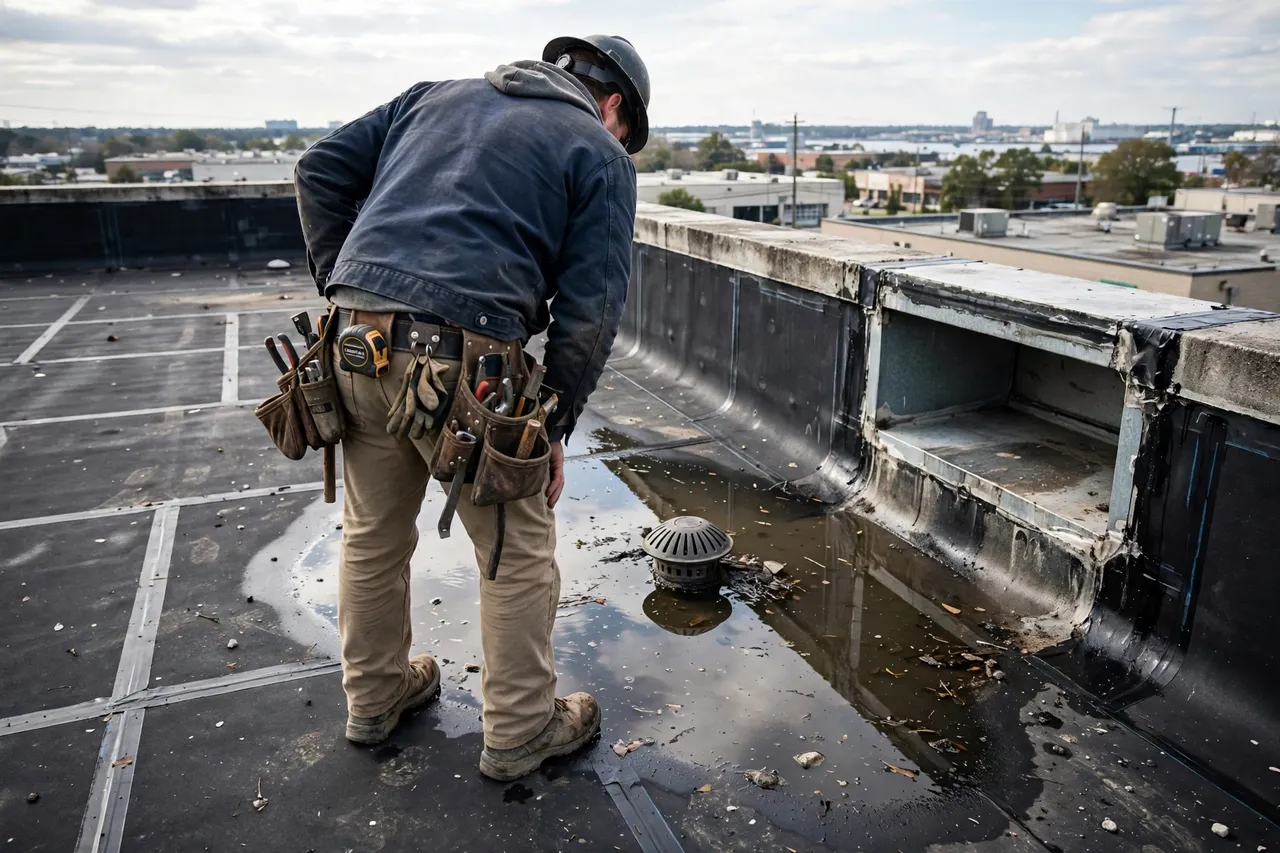
Wilmington has more flat roofs than most people realize. They cap the city’s rowhouses, cover porch and kitchen additions, and top the small commercial buildings along the city’s corridors. And they fail in ways that surprise homeowners who are used to pitched roofs, because a flat roof does not shed water — it manages it. Every gallon that falls on a flat roof has to find a drain or a scupper, and every seam, flashing, and penetration has to stay watertight while sitting in water that drains slowly. When any part of that system falters, the result is usually a leak that appears far from its cause.
The good news is that most flat roof problems announce themselves before they become serious, if you know what to look for. Ponding that lingers after rain, blisters in the membrane, seams that are lifting, and drains choked with debris are all visible warnings. This guide walks through the problems Wilmington flat roofs actually develop, why Delaware’s climate makes each one worse, and when a problem is a maintenance item and when it needs professional repair.
Why is ponding water the biggest flat roof problem?
Ponding water — standing water that remains on a roof more than a day or two after rain — is the single most destructive condition for a flat roof. It is also common in Wilmington, where older flat roofs were often built with minimal slope and where decades of settling, added rooftop equipment, and patched repairs have created low spots that were not in the original design. A roof that ponds is a roof whose seams and patches spend much of their life submerged.
Submersion is the problem. Seam adhesives and tapes are made to shed water, not to sit under it for days. Ponding water finds every weak edge, softens adhesives, and works into laps. It also adds weight — a single inch of standing water over a modest roof area weighs thousands of pounds — and that weight deflects the decking slightly, which deepens the low spot and makes the ponding worse. Left alone, ponding becomes a self-reinforcing cycle: deeper pond, weaker seams, more leakage, more deflection.
Ponding also feeds biological growth. Algae and moss take hold in standing water, and their root-like structures work into membrane surfaces. In winter, ponded water freezes and expands, stressing seams and flashings with each freeze-thaw cycle. If your flat roof still holds puddles two days after a normal rain, that is not a cosmetic issue. It is the earliest and most reliable warning that the roof’s drainage is failing, and it deserves a professional look before the next season adds to the damage.
What causes membrane punctures and tears?
Flat membranes — EPDM rubber, TPO, and modified bitumen — are tough but not invulnerable, and punctures are one of the most common flat roof failures in Wilmington. The causes are everyday ones: a dropped tool during rooftop HVAC work, a fallen branch, foot traffic from maintenance workers, or debris blown across the roof in a nor’easter. A puncture the size of a coin can admit a surprising amount of water, because water spreads under the membrane from the hole and soaks the insulation beneath it.
Punctures are hard to spot because the membrane often looks intact from above. The hole may be hidden under a layer of gravel, under a rooftop unit, or beneath ponded water. The first sign is usually a leak inside, and by then the insulation under the membrane may be wet across a wide area. That is why flat roof inspections include a hands-on walk of the surface, feeling for soft spots in the insulation that indicate trapped water.
Prevention is mostly about traffic discipline. Limit rooftop foot traffic, keep service workers to walkways or pads where they exist, and clear storm debris promptly rather than letting it grind into the membrane underfoot. When a puncture is found, the repair has to match the membrane: EPDM needs primer and seam tape, TPO needs a heat-welded patch, and modified bitumen needs a compatible torch-applied or adhesive patch. A generic sealant smeared over a puncture will peel away from the membrane within a season, for the same reasons a DIY roof patch fails on a pitched roof.
What are blisters and bubbles in a flat membrane?
Blisters are raised bubbles in a flat roof membrane, and they form when air or moisture trapped beneath the membrane expands in the sun. On a hot Delaware summer day, trapped moisture turns to vapor and pushes the membrane upward, sometimes into blisters the size of a dinner plate. Small, scattered blisters are common on older roofs and are not always a problem. Large blisters, blisters that split open, or blisters clustered near seams and flashings are a different matter.
A split blister is an open hole in the waterproofing layer. Even an intact blister is a weak point, because foot traffic or a dropped object can rupture it, and because the membrane stretched over the blister is thinner and weaker than the surrounding material. Blisters near seams are especially concerning, because the expansion stresses the seam adhesive and can peel the seam open from the inside.
Blisters usually point to moisture already trapped in the roof system — wet insulation, a leak elsewhere, or moisture sealed in during installation. That is why a roof with widespread blistering needs more than a patch. A roofer will check whether the insulation beneath is wet, because patching over wet insulation traps the moisture and leads to more blisters. In some cases, the blistered section and the wet insulation beneath it need to be cut out and replaced with dry material.
Why do flat roof seams fail?
Seams are where flat roof membranes join, and they are the most failure-prone part of any flat roof system. EPDM seams rely on adhesive tape or liquid adhesive. TPO seams are heat-welded into a single sheet. Modified bitumen laps are sealed with heat or adhesive. Every one of those bonds can fail, and Delaware’s climate gives them plenty of reasons to: ponding water soaking the seam, freeze-thaw cycles prying at the bond, thermal movement pulling the sheets in opposite directions, and ultraviolet exposure degrading the adhesive over time.
Failed seams announce themselves in stages. First, the edge of a seam lifts slightly, a condition roofers call fishmouthing, where the seam edge curls open like a small pocket. Then the lifted edge catches wind and water, and the opening grows. Finally, water enters freely, and the leak appears inside — often far from the failed seam, because water travels under the membrane before finding a path down.
Seam failure is rarely a single-seam event. When one seam fails from age or ponding, neighboring seams of the same age and exposure are usually close behind. That is why a flat roof repair for seam failure typically includes checking every seam on the roof, not just the one that leaked. Resealing a single seam while its neighbors are lifting is a short-term fix that will be revisited at the next storm.
How do clogged drains and scuppers cause leaks?
A flat roof is only as good as its drainage, and Wilmington’s flat roofs drain through a small number of points: interior drains, scuppers through the parapet wall, and gutters at the edge. Every one of them clogs. Leaves from the city’s street trees, granules washed off neighboring pitched roofs, trash blown across the roof, and even tennis balls and nesting material all end up in drains and scuppers. A single clogged drain can turn a normal rainstorm into a ponding event across the whole roof. Edge gutters on a flat roof behave like any other gutter, and a gutter repair that restores proper fall and reseals leaking joints keeps that drainage path working.
Interior drains are the most dangerous to neglect because the blockage is invisible from the ground. A drain basket full of debris lets water rise across the roof surface until it finds another way down — usually through a seam or a flashing detail that was never meant to be submerged. Scuppers clog more visibly, but they are often overlooked because they sit at the parapet edge, out of the normal line of sight from the street.
Drain maintenance is the highest-value habit a flat roof owner can adopt. Clearing drains and scuppers before Delaware’s storm season, and again after leaf fall in autumn, prevents the ponding that drives most other flat roof failures. It is also worth checking that drain strainers are present and seated: a missing strainer lets debris straight into the drain line, where it causes a blockage that is far harder to clear. If a drain backs up repeatedly despite clearing, the problem may be in the line below the roof, and that needs a plumber as well as a roofer.
What fails where a flat roof meets a wall or parapet?
The junction where a flat roof meets a parapet wall, a taller building wall, or a rooftop curb is a flashing detail, and flashing details are where flat roofs most often leak. The membrane has to turn up the wall and be sealed there, and that vertical seal moves: the wall and the roof expand at different rates, the sealant ages, and wind-driven rain hits the junction directly. Over time, the flashing pulls away, cracks, or loses adhesion, and water enters behind it.
Parapet caps add another failure point. The metal coping that caps a parapet wall has joints, and those joints rely on sealant. When the sealant fails, rain runs into the parapet itself, soaking the wall from the inside and appearing as interior stains that look like a roof leak but trace to the wall cap. Diagnosing this correctly matters, because resealing the roof membrane will not fix a leak that enters through the parapet cap.
Wall flashings also fail where rooftop equipment is involved. HVAC curbs, vent pipes, and skylight curbs each have their own flashing, and each one is a potential leak path. A curb flashing that was cut short, or a pipe boot that cracked in the sun, admits water directly into the building. On a flat roof, these details deserve as much attention as the membrane itself, because they are the places where the system is thinnest.
How do you tell a small flat roof problem from a serious one?
The dividing line is usually water: whether it is getting in, and whether the structure beneath the membrane is still dry. A single small blister on an otherwise sound membrane, a scupper that needs clearing, or a minor seam edge that is just starting to lift are maintenance items — worth fixing, but not emergencies. A leak inside the building, soft or spongy insulation underfoot, widespread blistering, or ponding that never drains are serious, because they mean the waterproofing layer has already been breached or the structure beneath it is wet.
Soft spots underfoot are the most telling sign. Walk a flat roof carefully — only when it is dry and you are sure of safe access — and feel for areas where the surface gives slightly under your weight. A firm, uniform surface means dry insulation. A soft, spongy area means wet insulation, and wet insulation does not dry out on its own inside a sealed roof system. It stays wet, grows mold, and rots the decking above and below it.
Interior signs help too. Stains on the ceiling below a flat roof, paint bubbling on the top-floor walls, or a musty smell in the rooms beneath the roof all point to water that has already entered. The longer those signs are present, the more likely the damage extends beyond the membrane into insulation and decking. A roof leak repair on a flat roof always starts with finding how far the water has traveled, not just where it is dripping.
When is professional repair needed for a flat roof?
Professional repair is needed whenever the membrane itself is breached, whenever seams are failing across more than a small area, whenever ponding persists after drains are cleared, or whenever the insulation beneath the membrane is wet. Those are system-level problems, and they need membrane-matched materials, proper seam preparation, and often a partial replacement of wet insulation. They are not fixed by a tube of sealant, and a sealant-only attempt usually makes the eventual repair harder by contaminating the membrane surface.
Professional repair is also the right call when the roof’s drainage design is the problem. If a roof ponds because it has no slope to its drains, or because its drains are too few or too small, no amount of patching fixes the underlying issue. A roofer can assess whether tapered insulation, an additional drain, or a scupper modification would solve the ponding, and that assessment is worth having before the next season of standing water does more damage.
What a homeowner can handle is the maintenance side: keeping drains and scuppers clear, keeping foot traffic off the membrane, and watching for the early signs — ponding that lingers, blisters, lifted seam edges, and debris buildup. Pair that vigilance with a periodic professional look, especially after Wilmington’s heavier storm seasons, and most flat roof problems get caught while they are still small. For a flat roof that is already leaking, or one where ponding and seam failure are both present, call for flat roof repair sooner rather than later — flat roof problems compound faster than pitched roof problems, because the water has nowhere to go.
Frequently Asked Questions
How long should water stand on a flat roof after rain? A healthy flat roof should drain within a day or two after normal rain. Water that still stands after 48 hours is ponding, and it means the roof’s slope or drainage is not working as it should.
What is the most common cause of flat roof leaks in Wilmington? Failed seams and clogged drainage share the top spot. Seams fail from ponding, freeze-thaw cycles, and age, while clogged drains and scuppers turn ordinary rain into ponding that stresses those seams further.
Can I seal a flat roof leak myself? Flat membranes need material-specific repairs: EPDM needs primer and seam tape, TPO seams are heat-welded, and modified bitumen needs a compatible patch. Generic sealants peel off membranes and can contaminate the surface for a proper repair later.
Are blisters on a flat roof a serious problem? Small, scattered blisters on an otherwise sound membrane are often just monitored. Large blisters, split blisters, or blisters near seams are serious, because they indicate trapped moisture and a weakened membrane that can rupture.
How often should flat roof drains be cleared? At least twice a year in Wilmington: before the autumn storm season and after leaf fall. Roofs under heavy tree cover may need more frequent clearing, since a single clogged drain can pond the whole roof.
Does a flat roof leak always mean the whole roof is failing? No. A single puncture, a failed seam section, or a clogged drain can cause a leak on an otherwise sound roof. Widespread blistering, multiple failed seams, or wet insulation across a large area are the signs of a system-level problem.
When should I call a professional for a flat roof problem? When the membrane is breached, when seams are failing across more than a small area, when ponding persists after drains are cleared, or when insulation beneath the membrane feels soft or wet. Those are system problems that need membrane-matched repair.
If your roof is showing any of the signs described here, or you would like a professional look at its condition, call The Roof Medics at (302) 445-8567. We will find the real source of the problem and lay out your repair options plainly.