Hail Damage Roof Signs: What to Look For
Hail damage often hides in plain sight. Here is how to tell hail hits from ordinary wear, and what to do after the storm passes.
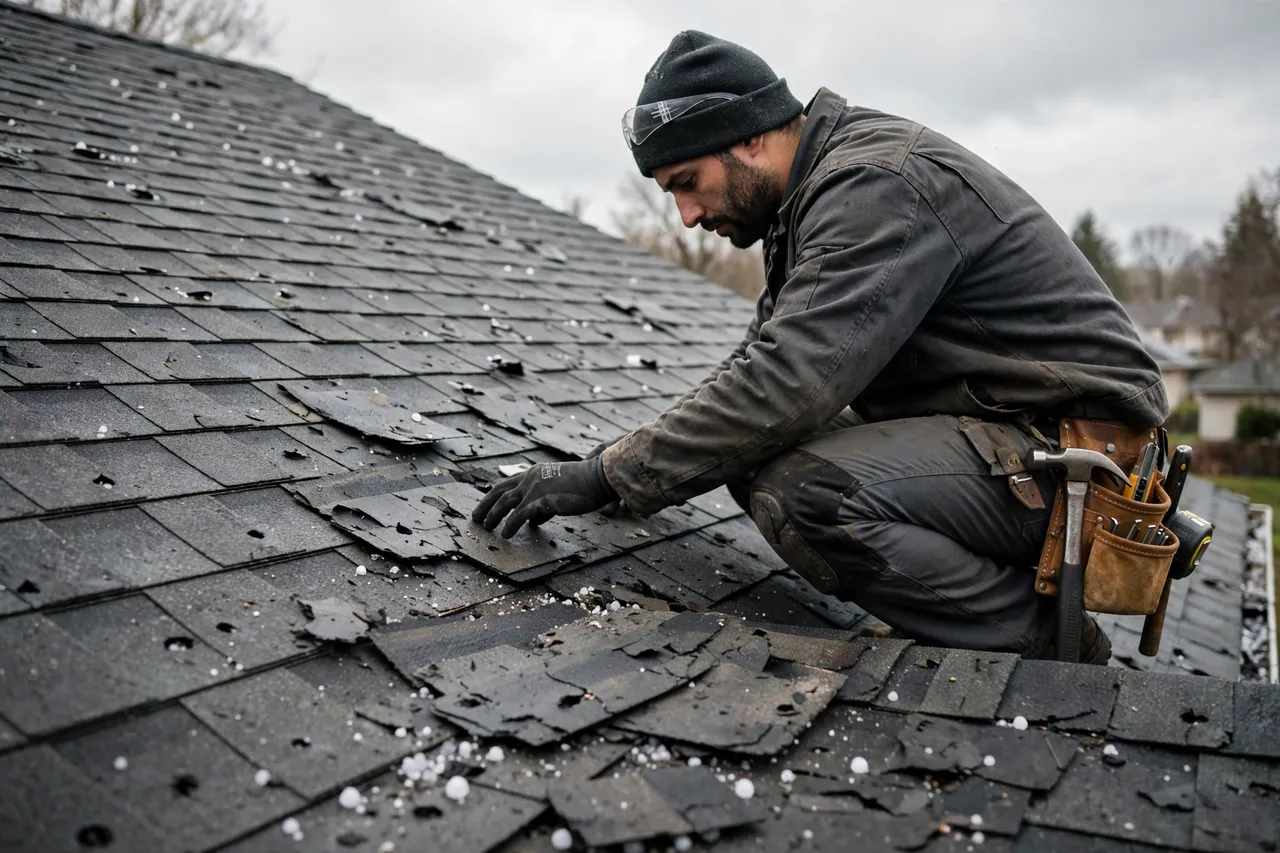
Hail does not always announce itself. A storm can drop stones the size of marbles for ten minutes, leave the lawn looking untouched, and still bruise hundreds of shingles. From the ground, a hail-damaged roof often looks perfectly normal. The damage is in the details: a soft dent in a shingle mat, a cracked granule surface, a split that only shows when the shingle flexes. That is why hail is one of the most commonly missed forms of roof damage in Delaware, and why so many hail-related leaks appear months after the storm, when nobody connects them to that one afternoon in July.
Delaware’s hail tends to arrive with the same summer thunderstorms and nor’easters that bring wind and heavy rain, which makes diagnosis trickier: wind damage and hail damage often appear on the same roof, and they need different repairs. This guide walks through the signs of hail damage on each roof type, the clues on gutters and vents that confirm hail fell, how to tell hail apart from ordinary wear, and the steps to take once you suspect your roof was hit.
What does hail actually do to a roof?
Hail damages a roof by impact. A falling stone strikes the shingle and drives its energy into the mat below the granule surface. The granules at the impact point are knocked loose or crushed, and the asphalt mat underneath can crack or bruise. The shingle may look almost normal afterward — a small dark spot where granules are missing — but its waterproofing layer is compromised at that point. Sun and rain then work on the weakened spot, and over the following months it can split, curl, or leak.
The severity depends on stone size, wind speed, and the roof’s condition. Small stones, roughly pea-sized, usually cause only cosmetic granule loss on a healthy architectural shingle. Stones approaching an inch or larger, especially when driven by wind, can crack shingles outright, dent metal, and split wood shakes. An older, brittle roof suffers more from the same storm than a young, flexible one, because brittle asphalt cracks where flexible asphalt absorbs the hit.
Hail also strikes unevenly. One slope can be hammered while the opposite slope is untouched, because hail falls at an angle with the wind. That is why a proper hail check covers every slope, not just the one facing the street. Damage that appears on one slope and not the others, with a clear directional pattern, is a classic hail signature.
What are the signs of hail damage on asphalt shingles?
The most reliable shingle sign is a random pattern of dark, circular spots where granules have been knocked away, exposing the black asphalt beneath. Run a hand lightly over a suspect shingle — hail hits often feel like a soft dent or bruise in the mat, a shallow depression you can press slightly. On a healthy shingle, the surface feels uniformly firm. A bruise feels different, and that difference is what inspectors look for.
Cracks are the next sign. Hail can split a shingle in a short, irregular crack radiating from the impact point, or crack the mat underneath while the surface looks intact. If a shingle flexes or cracks easily when lifted gently at its edge, its mat may be hail-damaged. Missing granules alone are not proof of hail — granules also shed with age — but a fresh, random scatter of impact marks after a known storm is strong evidence.
Look for collateral clues on the same slope. Dented or cracked vent caps, damaged skylight glazing, and split fascia boards all suggest the storm had the force to damage shingles too. And check the gutters: after a hailstorm, gutters often hold a noticeable amount of fresh granules washed off by the accompanying rain. A shingle roof repair after hail usually means replacing the damaged shingles individually, not patching over them, because a bruised mat cannot be restored by sealant.
How does hail damage show up on metal roofs?
On metal roofs, hail leaves dents. Small dents in flat panel areas are usually cosmetic — they do not break the weather seal — but dents at seams, ribs, or fastener lines matter more, because a deformed seam or a loosened fastener can let water in. Run a straight edge or simply sight along a seam after a storm. A seam that was straight and is now wavy at regular intervals has likely taken hail hits.
Coated metal adds another clue: hail can chip or crack the protective finish, exposing bare metal that will corrode, especially in Delaware’s humid, salty air. A chipped finish on a metal roof near the coast deserves attention even when the dent beneath it looks minor, because corrosion at the chip will spread under the coating over time.
Flat-seam and standing-seam systems hide hail damage better than shingle roofs do, which is one reason metal roof hail claims are often underestimated at first glance. The panels look fine from the ground while the seams tell a different story up close. If your metal roof has taken a storm with stones large enough to dent a car, it is worth a close look at the seams and flashings.
What do gutters, vents, and siding reveal about hail?
The parts of your home that are not the roof are often the best hail witnesses. Gutters and downspouts dent easily, and their dents are visible from the ground. Soft metals dent more readily than shingles, so a dented gutter or a cracked plastic vent cap after a storm is a strong hint that the roof took hits too. Window screens, siding, and outdoor furniture can also show pitting or cracking from the same storm.
Vents deserve special attention because they sit in the same plane as the shingles. A cracked turbine vent, a dented pipe boot collar, or a shattered skylight dome all confirm hail of damaging size fell on that roof. These components are also leak points in their own right: a cracked vent cap lets rain straight into the attic, even if the surrounding shingles survived.
Photograph these clues before anything is repaired. Dents in a gutter or a cracked vent cover are easy to document from the ground, and they help establish the storm’s severity. Note the date of the storm and keep any weather alerts or news reports about hail in your area. That record is useful whether you are arranging a repair or speaking with an insurer.
How do you tell hail damage from normal wear?
This is the question that matters most, because hail repairs and wear repairs are different jobs. Hail damage is random and directional: impact marks scattered without a pattern, concentrated on the windward slopes, often with collateral damage to vents and gutters. Normal wear is uniform: granule loss spread evenly across a slope, curling that follows sun exposure, and aging that looks the same on every side of the roof.
Blistering is the most common lookalike. Heat blisters form when moisture trapped in a shingle expands in the sun, leaving small raised bumps that eventually pop and leave a pitted crater. Blister craters look similar to hail hits, but they appear on sun-exposed slopes regardless of storm history, and they lack the soft bruise in the mat that characterizes a hail impact. A roofer can usually tell the difference by feel: a blister crater is shallow and the mat beneath it is intact, while a hail bruise has depth.
Age is the other distinguisher. A twenty-year-old roof will show granule loss, some curling, and a weathered surface whether or not hail ever fell on it. Hail on such a roof is still real damage, but it lands on material that was already near the end of its service life, which changes what a repair can achieve. A roof inspection after a hailstorm sorts out which marks are storm damage and which are age, and that distinction shapes the repair plan.
What should you do right after a hailstorm?
Start from the ground. Walk around the house and look for dented gutters, cracked vent caps, damaged siding, and granule buildup at the downspouts. Note which slopes face the direction the storm came from — those are the slopes most likely hit. Do not climb onto the roof yourself, especially while it is wet. Hail-damaged shingles are more fragile underfoot, and a steep or wet slope is dangerous without proper equipment.
It also helps to compare notes with neighbors. Hail falls in narrow bands, and one street can be hit hard while the next street over escapes untouched. If nearby homes show dented gutters, damaged siding, or roofers already inspecting their roofs, your roof likely took the same storm. If no neighbor shows any sign of hail, and your roof shows only uniform wear, the marks you found are more likely age than impact. That neighborhood context does not replace an inspection, but it sharpens the question the inspection needs to answer.
If you see signs of damage, arrange a professional inspection promptly, and document what you can from the ground with dated photos. Note the storm’s date and any hail reports for your area. If water is coming in, contain it inside with buckets and towels, move belongings out of the way, and call for emergency roof repair rather than waiting for a scheduled visit. A hail-damaged roof can leak at the next rain, not just the storm that caused the damage.
Resist the urge to have anyone apply sealant or tar over suspect spots as a quick fix. Sealant over a bruised shingle hides the damage without restoring the mat, and it can complicate a later repair or insurance assessment. The right first step after hail is a careful inspection, not a hurried patch.
How does documentation help with a hail claim?
If you plan to involve your insurer, documentation is everything. Insurers distinguish between storm damage and wear, and they look for the same signs described above: random impact patterns, collateral damage, and a storm date that matches weather records. A clear record — dated photos of dented gutters and vents, a written inspection noting impact marks and bruised shingles, and the storm’s date — makes that distinction straightforward.
Get the inspection done before repairs begin, and keep the damaged materials if any shingles are removed. An adjuster who can see the bruised mats and the impact pattern firsthand has far less to dispute than one working from a description alone. Our guide to roof storm damage and insurance walks through the documentation steps in more detail, including what adjusters typically look for on a Wilmington roof.
Timing matters too. Hail damage that is left through another season can be harder to attribute to a specific storm, especially once additional weather has added its own wear. If you suspect hail damage, do not let it sit until the next leak forces the issue. An early inspection costs little and preserves your options.
When does hail damage need repair, and when can it wait?
Hail damage needs prompt repair when it has broken the roof’s waterproofing layer: cracked shingles, bruised mats that flex or split, damaged vent caps, or dents at seams and fastener lines. Those are open paths for water, and every subsequent rain works on them. A roof with a handful of cosmetic granule scuffs and no mat damage can often be monitored, but that judgment should come from an inspection, not from a ground-level glance.
The other factor is the roof’s age and overall condition. Hail on a young, flexible roof is usually a straightforward repair: replace the damaged shingles, restore the vents, and the roof returns to full service. Hail on an old, brittle roof is a different situation, because the damaged shingles sit among neighbors that are already near the end of their life. In that case, a professional assessment of the whole slope is the honest next step, rather than a series of individual patches on failing material.
Whatever the verdict, the worst response to suspected hail damage is inaction. A bruised shingle does not heal, and the leak it eventually causes will damage decking, insulation, and ceilings — all of which are harder to fix than the shingle itself. If a storm dropped hail on your neighborhood, a storm damage roof repair inspection is the simplest way to find out where your roof stands.
Frequently Asked Questions
How can I tell if hail damaged my roof? Look for a random pattern of dark impact spots on shingles where granules are missing, soft dents or bruises in the shingle mat, and collateral damage such as dented gutters or cracked vent caps. A professional inspection confirms whether the marks are hail or ordinary wear.
Does small hail damage a roof? Pea-sized hail usually causes only cosmetic granule loss on a healthy architectural shingle. Stones approaching an inch or larger, especially when wind-driven, can crack shingles, dent metal, and break the waterproofing layer.
Can hail damage appear months after the storm? Yes. A bruised shingle mat may look intact at first and then split, curl, or leak over the following months as sun and rain work on the weakened spot. That delayed failure is why hail-related leaks often show up long after the storm.
Should I climb onto my roof to check for hail damage? No. Hail-damaged shingles are fragile underfoot, and a steep or wet slope is dangerous without proper equipment. Check from the ground for dented gutters and vents, and leave the roof surface to a professional.
Will hail damage always cause a leak? Not always. Cosmetic granule scuffs may never leak, but cracked shingles, bruised mats, and damaged vents are open paths for water. An inspection determines which marks are cosmetic and which need repair.
How is hail damage different from blistering? Hail damage is random and directional, concentrated on windward slopes with collateral damage to vents and gutters. Blistering is uniform, appears on sun-exposed slopes regardless of storm history, and lacks the soft bruise in the mat that marks a hail impact.
What should I document after a hailstorm? Dated photos of dented gutters, cracked vents, and damaged siding, the storm’s date, and a written inspection noting impact marks. Keep any removed shingles until an assessment is complete, so the damage can be seen firsthand.
If your roof is showing any of the signs described here, or you would like a professional look at its condition, call The Roof Medics at (302) 445-8567. We will find the real source of the problem and lay out your repair options plainly.