How Long Does a Roof Last in Delaware?
Delaware weather is hard on roofs. Here is how long each common roof type usually lasts here, and how to tell where yours stands.
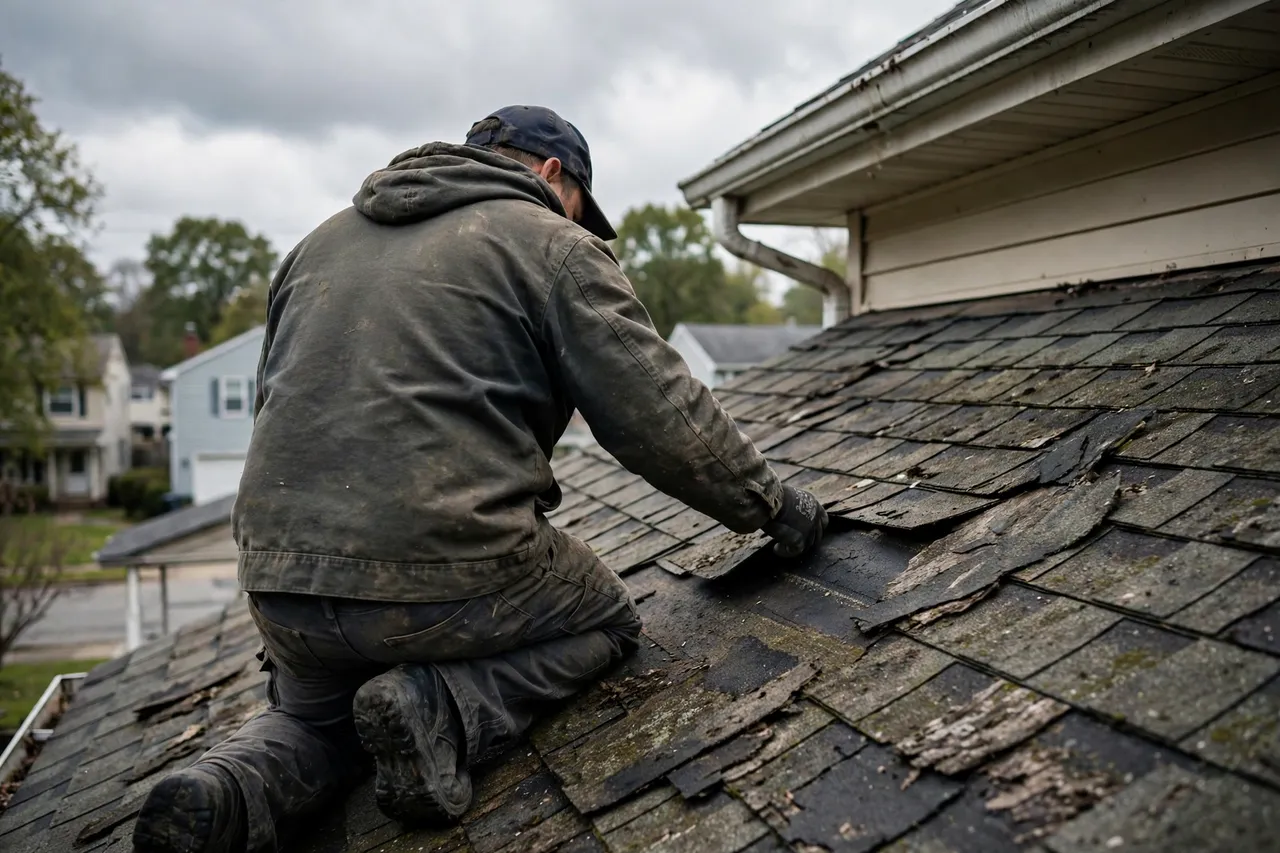
Delaware roofs live harder lives than roofs in many other parts of the country. A single year can bring a humid, sun-baked summer, a nor’easter driving rain sideways under the shingles, a tropical remnant dumping inches of rain in a day, and then a winter of freeze-and-thaw cycles that pry at every seam and fastener. Roofs here do not fail all at once. They wear down gradually, and the speed of that wear depends on the material overhead, how well it was installed, how well the attic breathes, and how much attention the roof has had along the way.
There is no single number that answers the lifespan question for every home. An architectural shingle roof on a well-ventilated house in Trolley Square can outlast a similar roof on a shaded, damp lot near Brandywine Creek by years. This guide walks through the typical lifespans of the roof types Wilmington homeowners actually have, what Delaware’s climate does to each one, and the signs that tell you whether your roof is aging gracefully or asking for help.
What wears Delaware roofs out faster than roofs elsewhere?
The first factor is water, in all its forms. Delaware sits in a humid mid-Atlantic climate where summer air stays damp for weeks, and moisture is the quiet enemy of every roofing system. Shingles that stay damp grow moss and algae, which hold still more moisture against the surface. Wood decking that never fully dries softens over time. Flat roofs that pond after every storm keep their seams submerged, which is exactly the condition seam adhesives are not made to endure indefinitely.
The second factor is temperature swing. A Delaware roof can bake above 140 degrees on a July afternoon and drop below freezing on a January night. That expansion and contraction works on shingles, fasteners, and sealants day after day. Sealant strips that hold shingles together lose their grip, nail holes widen slightly with each cycle, and brittle materials crack. Homes near the Delaware River and the bay get an extra dose of salt air, which speeds corrosion on exposed metal fasteners and flashing.
Then there is wind. Nor’easters are the signature Delaware storm, and they do not just bring rain. Sustained winds lift shingle tabs, drive rain uphill under laps, and peel back any edge that was already loose. A roof that survives ten quiet years can lose a section in one rough night if its shingles were already curled or its sealant strips had already weakened. That is why roof age and storm history belong in the same conversation: a twenty-year-old roof that has ridden out several nor’easters has simply had more wear than its calendar age suggests.
How long do asphalt shingle roofs last in Delaware?
Asphalt shingles are the most common roof in Wilmington, and they come in two broad families with different lifespans. Three-tab shingles, the flat, single-layer style found on many older homes, typically last around 15 to 20 years in Delaware’s climate. Architectural shingles, the thicker, layered style that dominates newer installations, typically last around 25 to 30 years. Those ranges assume decent installation and ventilation. A roof installed over old, uneven decking, or one with a poorly ventilated attic, will reach the end of its useful life sooner.
Shingles do not usually fail by wearing through. They fail by losing their protective granules, curling at the edges, and losing the sealant bond between courses. Granule loss shows up as bare, shiny patches and as grit collecting in the gutters. Curling shows up as cupped or clawed shingle edges that catch the wind. Once a significant share of a slope is curled or bare, that slope sheds water poorly, and leaks tend to follow. A shingle roof repair can replace damaged sections, but when the wear is spread across the whole roof, individual repairs stop being a lasting answer.
Color and slope matter too. Dark shingles on a low, south-facing slope absorb more heat and age faster than the same shingles on a steep, shaded north slope. That is why one side of a roof can look tired while the other still looks sound. Judging a roof by its worst slope is usually the honest approach, because water finds the weakest section first.
How long do metal roofs last in Delaware?
Metal roofs are the long-distance runners of the roofing world, and in Delaware they typically last 40 to 70 years depending on the system. Standing-seam metal roofs, where the panels lock together with raised seams and hidden fasteners, sit at the long end of that range. Exposed-fastener metal roofs, common on outbuildings and some additions, sit at the shorter end, because every exposed screw is a potential leak point as its rubber washer ages and the hole around it widens with thermal movement.
Delaware’s coastal air is the main thing to watch with metal. Salt accelerates corrosion, especially on lower-grade steel and on any spot where the protective finish has been scratched down to bare metal. Aluminum and properly coated steel hold up better near the water. Hail and falling branches can dent metal panels, and while a dent is often cosmetic, a deep dent at a seam can break the weather seal and let water in. A dented seam deserves a look even when the rest of the panel looks fine.
Metal roofs also move with temperature more than shingles do. Panels expand and contract along their length, which is why standing-seam systems use clips that let the panel slide. When those clips fail or panels were installed too tightly, the roof can oil-can — a visible waviness — or stress its fasteners. None of this means metal is a poor choice for Delaware. It means the installation details matter even more than the panel itself, and a metal roof repair that addresses the failed detail, rather than just the visible symptom, is the one that lasts.
How long do flat roofs last in Delaware?
Flat and low-slope roofs, common on Wilmington rowhouses, porch additions, and commercial buildings, typically last 20 to 30 years depending on the membrane. EPDM rubber membranes are known for flexibility and long service when their seams hold. TPO membranes, the white single-ply sheets seen on many commercial buildings, resist heat well but depend entirely on heat-welded seams. Modified bitumen, the torch-applied or peel-and-stick layered system, performs well when its laps are sealed and its surface stays protected from standing water.
The enemy of every flat roof in Delaware is ponding water. A roof that holds puddles for more than a day or two after rain is a roof whose seams, patches, and drains are working overtime. Ponding accelerates seam failure, feeds algae growth, and adds weight that can deflect the decking and make the ponding worse. That cycle is the reason flat roof problems tend to escalate: a small low spot becomes a permanent pond, and a permanent pond becomes a leak.
Flat roofs also fail at their edges and penetrations — where the membrane meets a parapet wall, wraps a drain, or flashes around a vent pipe. Those details move, crack, and peel long before the open field of the membrane wears out. A flat roof repair that reseals a failing seam or rebuilds a drain flashing can add years to a flat roof’s service life, provided the membrane itself is still sound and the decking underneath is dry.
What signs show a roof is nearing the end of its service life?
The clearest sign is wear that is widespread rather than localized. A few missing shingles after a storm are a repair. Curling, granule loss, and brittleness across most of a slope are a roof telling you its material is exhausted. Run a hand — from a ladder, never by walking a fragile slope — over a shingle tab. If it feels brittle and cracks instead of flexing, the asphalt has lost its pliability, and that shingle will not reseal or shed water the way it once did.
Inside the house, the signs are stains that keep returning in different places, a musty smell in the attic, or daylight visible through the roof boards. Attic stains that appear in one spot, get repaired, and then appear somewhere else are a pattern worth taking seriously: they suggest the waterproofing layer as a whole is letting water through, not just one failed detail. Daylight through decking boards means gaps have opened where boards have shrunk or rotted, and those gaps will only grow.
Granule loss deserves its own mention because it is easy to miss. Check the gutters and the ground below the downspouts after a heavy rain. A handful of granules is normal on a young roof. A thick, sandy layer, year after year, means the shingles are shedding their protective surface, and once that surface is gone, the asphalt underneath breaks down quickly under sun and rain.
Does an older roof always need attention?
Age alone does not condemn a roof. A well-installed architectural shingle roof with good attic ventilation, sound flashing, and a history of prompt small repairs can serve well past the middle of its expected range. Equally, a younger roof that was installed over rotted decking, or one whose attic runs hot and damp every summer, can be in trouble long before its expected lifespan is up. Condition, not the calendar, is what decides whether a roof needs work.
That is why a periodic roof inspection matters more as a roof ages. An inspection looks at the details homeowners cannot easily see from the ground: the condition of pipe boots and flashing, the state of the valleys, whether the shingles still seal, and whether the attic shows staining or damp insulation. For roofs past about fifteen years, an inspection every year or two catches the small failures — a cracked boot, a lifted valley shingle — before they become interior damage.
Think of it the way you would think of an older car. The question is not how many years it has, but how it has been maintained and what its current condition is. A roof with a documented history of small, timely repairs is a very different prospect from a roof of the same age that has never been looked at since installation day.
How do Wilmington’s older homes change the picture?
Wilmington’s housing stock adds wrinkles that newer suburbs do not have. The Victorian-era homes of Trolley Square, the early-1900s colonials of the Highlands and Forty Acres, and the brick rowhouses of the city’s older neighborhoods often have steep pitches, plank decking instead of plywood, and layers of roofing history — sometimes two or three roofs stacked on top of each other from decades of re-roofing over the old layer.
Steep pitches shed water well, which helps, but they also make every detail harder to install correctly and harder to inspect safely. Plank decking moves with humidity in ways plywood does not, and gaps between planks can telegraph through shingles over time. Multiple layers add weight and trap heat, which ages the top layer faster, and they hide the condition of the decking underneath. On these homes, the age of the visible shingles is only part of the story; what lies beneath them matters just as much.
Older homes also tend to have more roof penetrations — old chimneys, abandoned vents, skylights added in a later renovation — and every penetration is a flashing detail that needs to hold. When assessing an older Wilmington roof, pay as much attention to the chimneys, valleys, and wall junctions as to the field shingles. Those are the places where age shows up first.
When is repair the right call, and when is an assessment the wiser step?
Repair is the right call when the damage is localized and the surrounding roof is still sound. A section of wind-lifted shingles, a cracked pipe boot, a failed valley flashing, or a punctured flat membrane are all problems a targeted repair solves well, and solving them promptly protects the rest of the roof. The key test is the condition of the material around the damage. If the neighboring shingles are flexible, sealed, and holding granules, a repair has something solid to tie into.
An assessment becomes the wiser step when the problems are widespread, recurring, or structural. If leaks keep appearing in new places, if a large share of the slope is curled or bare, or if the decking feels soft underfoot in the attic, the honest question is no longer whether one more patch will hold. It is whether the roof system as a whole can still do its job. A roofing professional can look at the full picture — material condition, decking, ventilation, and flashing — and lay out the options plainly.
There is a middle ground that Wilmington homeowners use often: repair now, plan ahead. A sound repair can buy a roof several more seasons of service while you plan for a larger project on your own timetable, rather than under the pressure of an active leak. The important thing is that the repair is made with open eyes, knowing what shape the rest of the roof is in. Our guide to roof repair vs replacement signs walks through that decision in more detail.
Frequently Asked Questions
How long does an asphalt shingle roof last in Delaware? Three-tab shingles typically last around 15 to 20 years in Delaware, while architectural shingles typically last around 25 to 30 years. Ventilation, installation quality, and storm history all move a specific roof within or beyond those ranges.
Do metal roofs last longer than shingles in Delaware’s climate? Yes, generally. Metal roofs typically last 40 to 70 years depending on the system, compared with 15 to 30 years for asphalt shingles. Standing-seam systems with hidden fasteners sit at the longer end, while exposed-fastener systems need more attention to their screws and washers.
Does living near the Delaware coast shorten a roof’s life? It can, mainly through salt air, which speeds corrosion on exposed metal fasteners and flashing. Roofs near the river and bay benefit from corrosion-resistant materials and closer attention to flashing and fastener condition.
Can a roof last longer than its typical lifespan? Yes. Good ventilation, sound installation, and prompt small repairs regularly carry a roof past the middle of its expected range. Conversely, a neglected or poorly ventilated roof can fail well before its expected lifespan.
How often should an older roof be inspected? Once a roof passes about fifteen years, an inspection every year or two is a sensible rhythm, plus an inspection after any major storm. Catching a cracked pipe boot or a lifted valley shingle early prevents interior damage.
What is the first sign a roof is wearing out? Widespread granule loss is often the earliest visible sign: bare patches on shingles and sandy grit collecting in gutters. Curling shingle edges and shingles that feel brittle instead of flexible are close behind.
Is it worth repairing a roof that is near the end of its life? A targeted repair is worthwhile when the damage is localized and the surrounding material is still sound. When wear is widespread and leaks keep appearing in new places, an assessment of the whole roof system is the wiser step.
If your roof is showing any of the signs described here, or you would like a professional look at its condition, call The Roof Medics at (302) 445-8567. We will find the real source of the problem and lay out your repair options plainly.